


Gain access to personalized product screening, the best pricing, rewards, and more!
Create An Account, Or Sign In.
Most Effective Products
Gypsy Moth Control: How to Get Rid of Gypsy Moths
This page is an expert guide on getting rid of gypsy moths from your property using the products and methods suggested by our experienced pest control specialists. Follow this guide and use the recommended products, and you will eliminate gypsy moths from your property, which is guaranteed.
When summer arrives, there is no shortage of pests that come out of hibernation and start to create problems around a home or garden. One such pest that is becoming an increasing issue due to the damage it causes is the gypsy moth.
Gypsy moth caterpillars do the bulk of their damage around agricultural crops and in forests, consuming leaves and plants in large numbers. In recent years, however, they've moved onto backyards and lawns in neighborhoods where they can ruin a landscape quickly without intervention.
If you have a gypsy moth invasion on your property, this DIY guide can help. Read on below for expert advice and top product recommendations to eliminate gypsy caterpillars quickly and affordably.
Identification
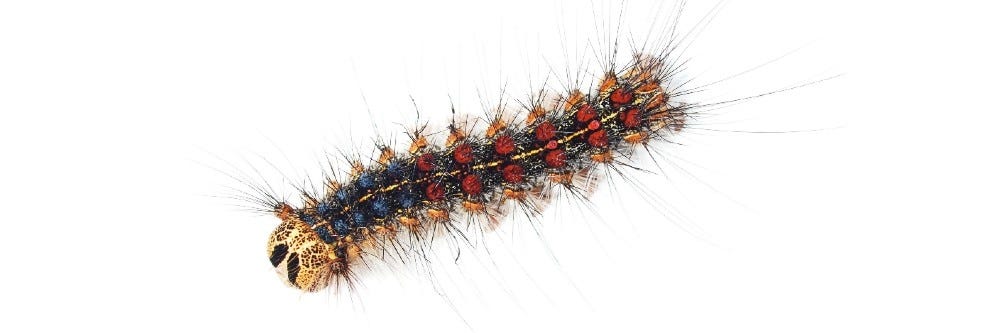
Before you can proceed with treatment, you need to be sure that the pest you are dealing with is a gypsy moth caterpillar and not some other insect. Misidentification can lead to using the wrong treatment methods and products, which can end up being a waste of time and money. Here are some identifying characteristics of gypsy moth caterpillars:
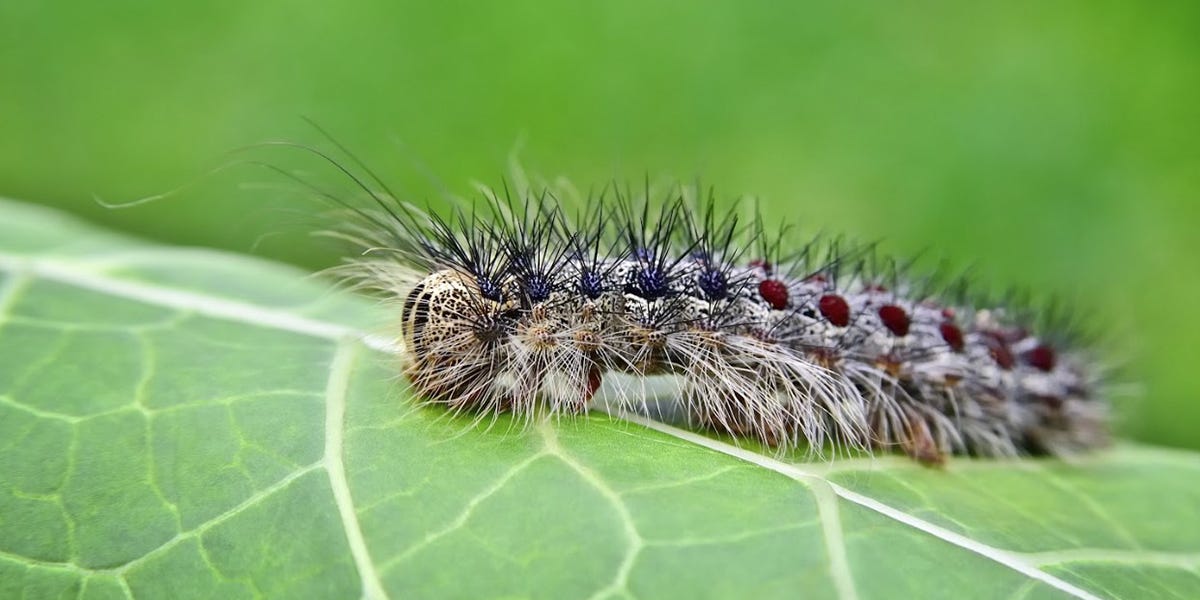
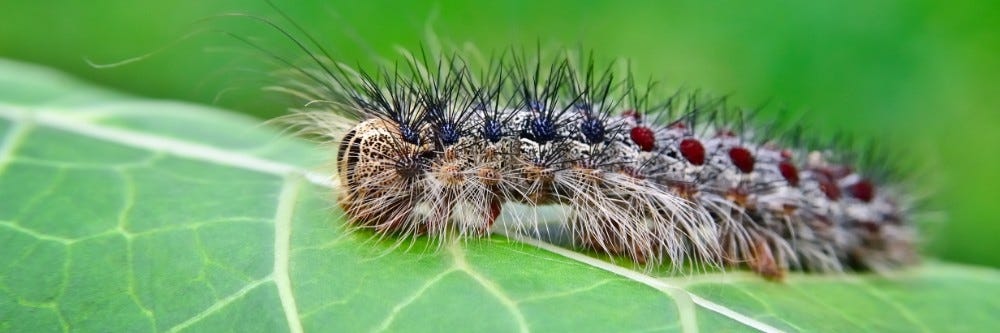
- Gypsy moth caterpillars are the larvae stage of the adult gypsy moth (also known as spongy moth). Newly hatched gypsy moth larvae are about 1/4 inch, black, and hairy. As they grow, they develop a mottled yellow-gray body covered with tufts of black hairs. The mature caterpillars reach about 2 to 2.5 inches long and have 11 body segments, each with two distinctive colored spots. They will also have 5 pairs of blue spots near the head, followed by 6 pairs of red spots toward the rear. Their head is a dirty yellow color marked with 2 vertical black bars that resemble eyes, and their bodies are covered in bundles of bristles with 2 lines of colored warts running along their backs.
- When they reach adulthood, the male gypsy moth will be smaller than the female species with a wingspan just under 2 inches. The male has an mottled light and dark brown wings featuring an inverted black "V" shape called a chevron. The female, slightly larger with about a 2.5-inch wingspan, is almost entirely white with only a few dark markings on her wings and cannot fly like the male.
Use the description and image to help you properly identify the gypsy moth caterpillar on your property. If you are unsure, contact us; we will try to help you get the correct identification.
Inspection
Once you have confirmed that you are dealing with gypsy moths, you can move on to inspection. During this phase, you will need to find out where the gypsy moths are located and the places they are infesting. This will help you in determining where to focus your treatment application.
Where To Look
Gypsy moths mainly infest trees, particularly favoring oak, birch, aspen, willow, and maple, but they will also feed on apple, hawthorn, and various shrubs.
What To Look For
Look for egg masses, which the female moth deposits on trees, outdoor equipment, vehicles, and other surfaces; these tan, fuzzy clusters can overwinter and hatch in late spring or early summer.
Newly hatched larvae can "balloon" on silk threads to travel short or long distances. Mature larvae feed voraciously on tree leaves, often causing severe defoliation, leaving trees with skeletonized leaves or completely bare branches.
Gypsy moth caterpillars are nocturnal feeders and hide in shady areas during the day. In early to mid-summer, caterpillars pupate under bark flaps, signs, or branches, spinning silk cocoons. In late July, the adults will emerge to reproduce.
Female moths cannot fly, so they will release pheromones to attract males. Often, the females will crawl over tree trunks, branches, on the ground, and any other sheltered place until the male finds them.
Unlike some pests, gypsy moth caterpillars do not build tents or webbed nests, so webbing near defoliated trees suggest a different insect.
Treatment
Once you have pinpointed the areas where the gypsy moth caterpillar is most active, you can then move forward with applying treatment products. Before you handle any pesticides, you will need to wear the proper personal protective equipment (PPE).
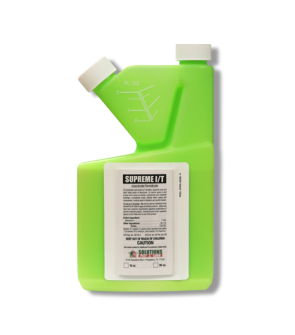
By far, the most effective method of dealing with these unwanted visitors to your property is insecticides. Our top recommendation for gypsy moth caterpillars is Supreme IT Insecticide.
Step 1: Mix and Apply Supreme IT
Supreme IT is a broad-spectrum insecticide that is labeled for treating over 70 different pests, including gypsy moth caterpillars and moths. Once applied, it will create a long residual effect that can continue to control pests for up to 90 days after application.
Determine how much Supreme IT to use by measuring the square footage of the treatment area. Find the square footage by measuring the treatment area's length and width in feet, then multiplying them together (length X width = square footage).
To get rid of gypsy moth caterpillars, apply 0.125 to 0.25 fl. oz. of Supreme IT per 1 gallon of water per 1,000 sq. ft.
To control adult moths, mix 1 fl. oz. of product with 1 gallon of water per 1,000 sq. ft.
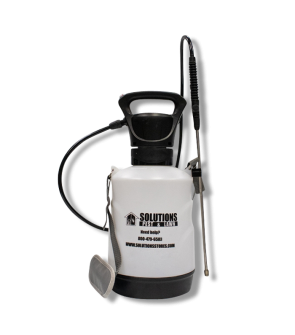
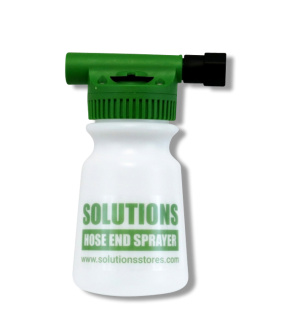
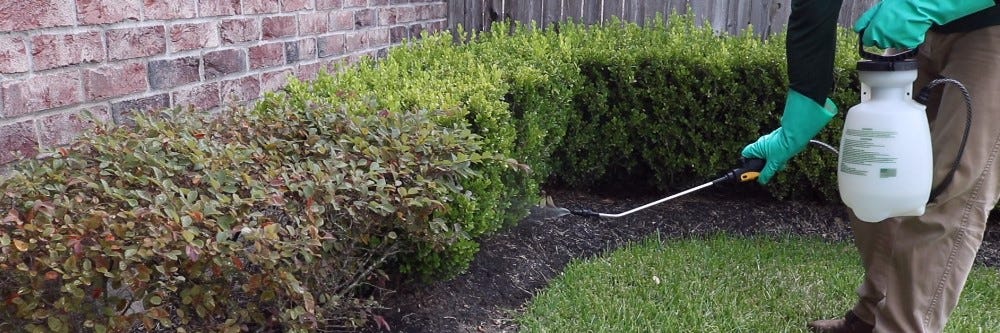
This product will need to be mixed with water in a handheld pump or back sprayer. If you need to reach elevated areas such as trees, we suggest using the Solutions Hose End Sprayer.
Mix the product in a sprayer and spray Supreme IT over your yard and garden via fan spray to get uniform coverage. Spray your whole lawn, starting from the back to the front.
Also, spray ornamentals and landscaping, focusing only on non-edible vegetation areas. Do not spray fruit-bearing trees or flower beds.
Do not allow people or pets to enter the treated area until the spray has completely dried.
Prevention
Prevention is the final step to completely control gypsy moths and limit the possibility of re-infestation. Some preventative measures you can take against gypsy moths are listed below:
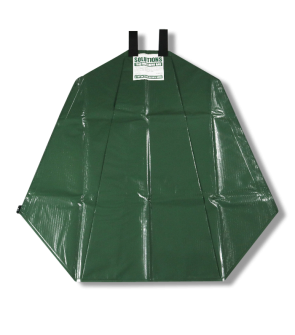
- Keep trees and shrubs healthy with proper watering, fertilization, and pruning as healthy plants tolerate feeding better and recover master. Remove loose bark and debris from tree trunks where larvae and pupae like to hide. We suggest using the Solutions Tree Watering Bag, which will slowly release 20 gallons of water to the tree. To determine the diameter of your tree at diameter breast height (DBH), measure 4.5 feet up from the ground, wrap a measuring tape around the trunk at that height, and record the measurement. Use one Solutions Tree Watering Bag for trees up to 3 inches in diameter, or zip two bags together for trees between 4 and 8 inches. Wrap the bag around the trunk with the tag facing outward and zip it closed from bottom to top. Lift the tag, insert a hose into the opening, and begin filling the bag, first to about one-quarter full to help it settle, then continue filling to the desired level. Once filled, the bag will empty in approximately 8 to 10 hours, and most trees will need to be watered once a week.
- Inspect firewood, outdoor furniture, trailers, and equipment before moving them, especially from infested areas, to avoid accidentally transporting egg masses.
- You can also install barrier bands or burlap bands around tree trunks to trap wandering caterpillars during an outbreak. Regularly inspect around your property and gently scrape egg masses from surfaces into a disposable plastic bag and place in outdoor trashcan. Be sure to wear gloves as the hairs can irritate your skin. Removing egg masses before they hatch, combined with trapping caterpillars as they crawl, significantly reduces the population and better protects desired foliage.
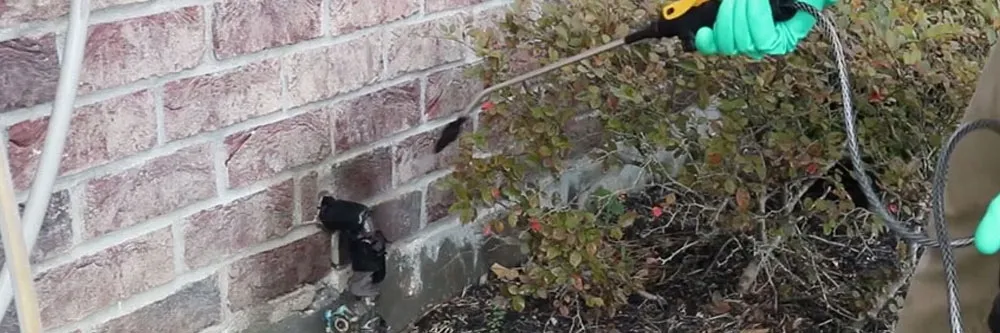
- Lastly, the best way to prevent gypsy moths is to spray Supreme IT in early spring, again in mid-May to early June, and throughout the year every 3 months. Be sure to create a perimeter treatment around your home by spraying 3 feet up the structure and 3 feet out on the ground next to it. Be sure to also spray around window and door frames, eaves, soffits, and cracks and crevices. Next, broadcast the solution evenly across your yard to ensure total control.
Key Takeaways
What are Gypsy Moth Caterpillars?
- The gypsy moth caterpillar is a caterpillar species known for its hairy appearance and plant destruction in forests and agriculture. Still, it has become increasingly prevalent in residential yards and landscapes.
How To Get Rid of Gypsy Moth Caterpillars
- We recommend controlling gypsy moth caterpillars with an application of Supreme IT to protect your yard plants.
Preventing Gypsy Moth Caterpillar Reinfestation
- To prevent gypsy moths, applications of Supreme IT in early spring, again in mid-May to early June, and every 3 months while also treating the homes perimeter and yard will make it unlikely that the gypsy moth caterpillar re-emerges. Keep trees healthy with proper care, remove loose bark, inspect items before moving, and use Solutions Tree Watering Bags to further reduce gyspy moth populations and protect foliage.