


Gain access to personalized product screening, the best pricing, rewards, and more!
Create An Account, Or Sign In.
Foams
A foam adjuvant is a product that turns a substance that is normally liquid, such as a pesticide, and makes it so that it is in a different formulation via trapping pockets of gas.
When a foaming instrument or product is used with an insecticide, it takes the insecticide and alters its formulation so that the product can flow in a way that reaches more areas and gets better coverage.
Foam is a popular tool used in pest control situations and is used as an adjuvant for pesticides to improve its reach and fill voids where pests may be hiding or otherwise cannot be reached via conventional pesticides. This type of product application is particularly useful for wood-destroying insects such as termites and carpenter ants, where the infested area is not easily accessible without removing large parts of the interior or exterior structure.
A variety of pesticides can be foamed. All that is required to achieve foaming capabilities is the use of a foaming agent that is to be mixed with the liquid insecticide. Then a foaming instrument is used to put in the air needed to change the liquid into a foam to be applied to the target area.
Shop our top recommended foam agents and products below. If you need help selecting the right foaming agent or instrument or would like more information on how to foam a pesticide properly, our experienced pest control specialists will be more than happy to help you.
Our Recommendation
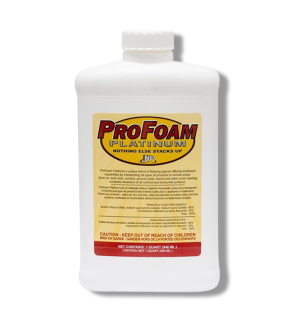
- ProFoam Foaming Concentrate - is an excellent tool because it boosts the accuracy and coverage of a pesticide because it won’t be hindered by gravity like a liquid or dust treatment would. With foam having the ability to expand, it allows great coverage and penetration when applied in difficult-to-reach voids and small spaces.
For instance, if a wall void needed to be treated for termites, spraying in a liquid would be ineffective as it would fail to reach key areas. On the other hand, using a pesticide like ProFoam Foaming Concentrate with foaming capabilities would get a much better reach and coverage because the foam would expand and fill the entire void, allowing the active ingredient to bond with all surfaces.
In addition, we do have products in our inventory that have built-in foaming capabilities and come ready to use, such as FiPro Foaming Aerosol. This ready-to-use foam is especially useful for those that just want to get the right to treat labeled pests and treatment sites and avoid doing the mixing themselves.
It would be best to mix a concentrate with a foaming agent for large areas, as using multiple ready-to-use products would be too expensive.
Tools Needed
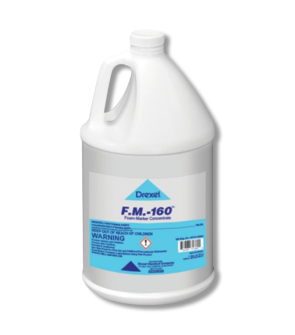
- Foaming Concentrate
- Selected Insecticide Concentrate
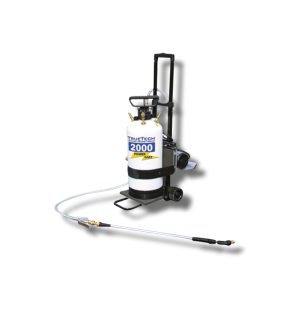
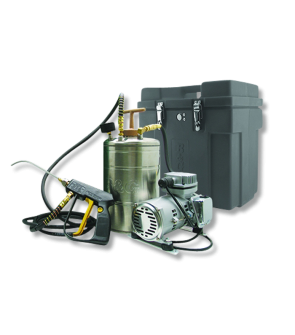
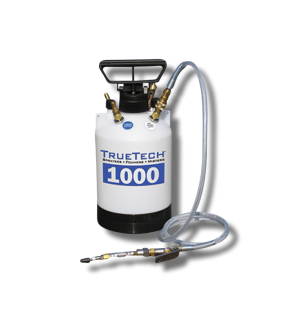
- Foamer Applicator
PPE
- Chemical Resistant Gloves
- Dust / Mist Mask
- Safety Glasses
How to Use Foams
Step 1: Mix up the Insecticide concentrate
Make sure that you always read and follow the label instructions for proper mix and usage rates.
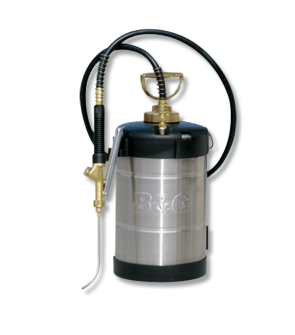
Dilute the concentrate according to the label in the foaming device, or in this case, the B&G Versafoamer.
Step 2: Add The Foaming Agent
Add ProFoam Foaming Concentrate to the diluted pesticide solution you just mixed. The amount of foaming agent needed to add to the mixture depends on the treatment area, and what the insecticide label says about foaming in product. Not every product can or should be turned to foam.
To achieve low expansion (1-7 to 1) add 0.5 to 1.5 oz per gallon of finished solution. To achieve high expansion (8-20 to 1) mix 1.5 to 9 oz. per gallon of finished solution.
Step 3: Apply the Foam To Target Area Using Foaming device
With your PPE on, begin applying the foam mixture you created the target area where the pest is infesting. This should particularly be used in cracks, crevices and voids so focus your application in these areas.
The foam should fill the voids perfectly and reach any pest that is hiding in the deepest of hiding places. Do not over-apply to the point where the foam solution begins spilling out of the treated void or crevice.
Step 4: Reapply As Needed
Check back after a few days to see how much is left of the infestation. Depending on the targeted pest and the pesticide used, another follow-up application may be necessary if there is a sizable population.
Key Takeaways
- Foaming adjuvants are a helpful additive to mix with pesticides and apply to hard-to-reach areas where pests are known to hide.
- Our top recommendation for Foaming is mixing ProFoam Foaming Concentrate in a B&G Versafoamer with your selected pesticide product.
- Apply foam directly into cracks, crevices and voids so the foam will expand and reach the pests.