


Gain access to personalized product screening, the best pricing, rewards, and more!
Create An Account, Or Sign In.
Most Effective Products
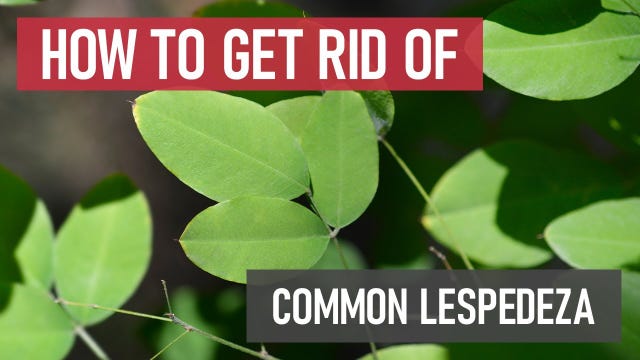
Common Lespedeza Control: How to Get Rid of Common Lespedeza
This page is a general DIY guide for controlling common lespedeza. Using the products and methods suggested, you will get control of common lespedeza. Follow this DIY article and use the recommended products; we guarantee 100% control of common lespedeza.
Though common lespedeza, also known as Japanese clover, annual lespedeza, or bush clovers appear innocent with its clover-like leaves it's a nightmare to deal with.
Common lespedeza can easily outcompete other vegetation by forming dense stands. Not to mention this weed can survive mowing heights less than 1 inch making it harder for just simple manual removal.
As long as common lespedeza is present in your property you can expect a complicated mess of weeds, death of desired plants, and lower nutrients in soil. However, by taking on some of the information and use of the following products in our DIY guide you can easily control common lespedeza.
Identification
Before proceeding with a treatment program, you need to be certain that the weed infesting your property is common lespedeza. Careless identification can lead to using the wrong treatment methods, which can waste time and money. Listed below are some characteristics to aid you in identifying common lespedeza.
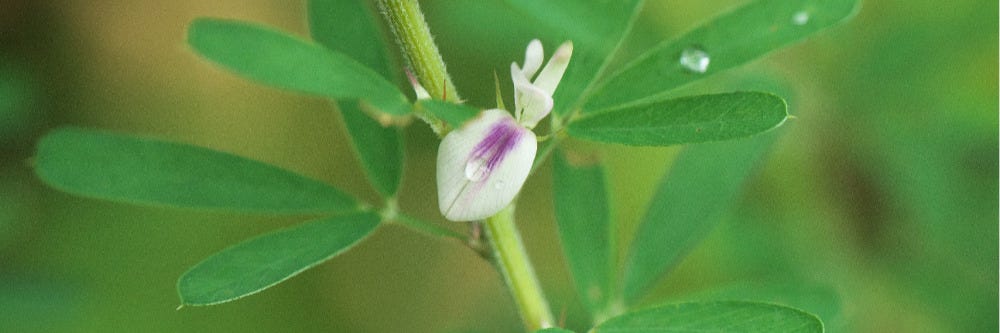
- Common lespedeza typically grows prostrate, or horizontal along the ground. While this weed typically grows low, it can grow up to a height of 18 inches, forming patches up to 18 inches in diameter.
- The leaves are dark green in color, and grow as trifoliates. Each leaflet is 1/2 to 3/4 inches long and 1/3 to 1/2 wide. They are oval-shaped with smooth edges, and have prominent mid-veins with branching parallel veins.
- During the late summer, pink to purple flowers are produced. A single flower can be found on the leaf axis.
- The stems of common lespedeza are wiry, prostrate, green to purplish in color, and have short white hairs pointed downward.
Use the description and image above to help you correctly identify common lespedeza on your property. If unsure, contact us and send a photo of your weed through email or in person at one of our stores to help you identify the weed and suggest treatment options.
Inspection
Once it is confirmed that you are dealing with common lespedeza, you can move on to inspection. During this phase, you will locate areas where lespedeza are thriving and observe the conditions allowing them to succeed. This information will help you in knowing where to focus your herbicide application.

Where to Inspect
Common lespedeza likes to grow in areas with thin turf, poor nitrogen, and dry or compacted soil.
Sites where common lespedeza is typically found are golf courses, disturbed areas, fields, lawns, open woods, and other areas with low fertile soils.
What to Look For
Common lespedeza is a freely branched weed that grows low to the ground from July to mid-October.
Younger common lespedeza will have wiry, slender stems whereas the stems of more mature plants are harder and woody.
Treatment
After identifying common lespedeza and inspecting where they are most active in your property, you can begin to treat your area. Be sure to wear the proper personal protective equipment (PPE) before handling or applying any herbicides.
Using a post-emergent herbicide containing metsulfuron, dicamba, triclopyr, triazine, atrazine, or 2,4-D will have significant results against common lespedeza.
Best control results are seen when the weed is actively growing so post-emergent herbicide applications should start in the spring.
Step 1: Mix and Apply Herbicides
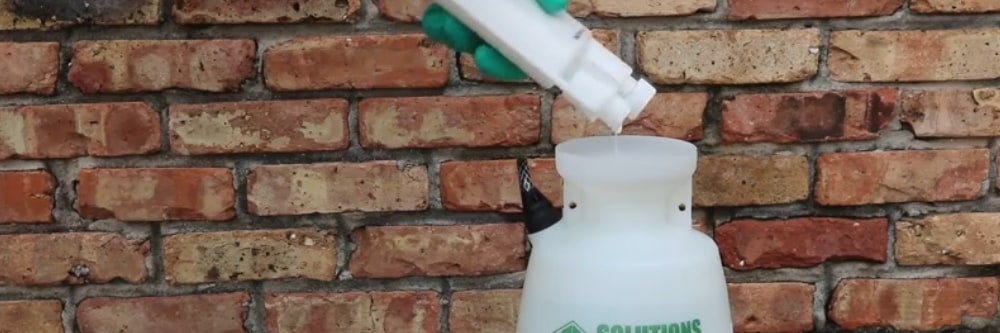
Determine how much herbicide to use by measuring the square footage of the treatment area. Find the square footage by measuring the treatment area's length and width in feet, then multiplying them together (length X width = square footage). For acreage, take the square footage and divide it by one acre (square footage / 43,560 sq. ft. = acres).
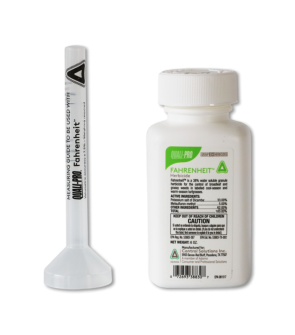
For common lespedeza control in warm-seasoned turf check out Fahrenheit Herbicide. Fahrenheit Herbicide is a post-emergent herbicide formulated as a water-dispersable granule to kill broadleaf and grassy weeds in warm-seasoned turf.
A spot treatment with Fahrenheit Herbicide will use 0.2 oz. of product in 1 gallon of water to cover 1,000 sq. ft. of turf.
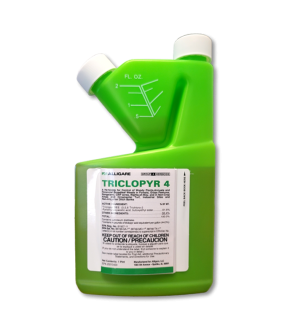
To get rid of common lespedeza in cool-seasoned turf use Triclopyr 4ec Herbicide. Triclopyr 4ec Herbicide is a post-emergent emulsifiable concentrate herbicide designed to control woody plants, brush, and broadleaf weeds.
Perform only a spot treatment with Triclopyr 4ec Herbicide. This product may injure certain turfgrass species so broadcast applications are not recommended.
To use Triclopyr 4ec Herbicide as a spot treatment in cool-seasoned turf apply at the rate of 3/8 to 3/4 fl. oz. of product per 1 gallon of water per per 1,000 sq. ft.
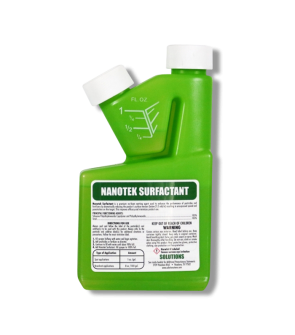
We recommend using a surfactant such as Nanotek during your herbicide applications. Nanotek Surfactant is a non-herbicide product designed to improve the adhesion and penetration of pesticides onto treated surfaces.
To use Nanotek Surfactant, add 1 fl. oz. per 1 gallon of solution.
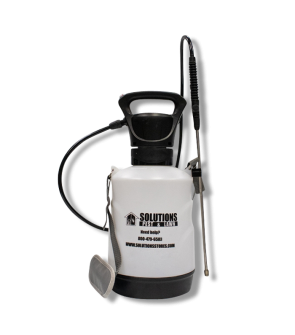
Mix and apply these products in a handheld or backpack sprayer.
To mix, you will need to fill the spray tank with half the amount of water. Pour in the proper amount of herbicide and Nanotek Surfactant then add in the remaining half of the water. Close the tank lid and shake until well-mixed.
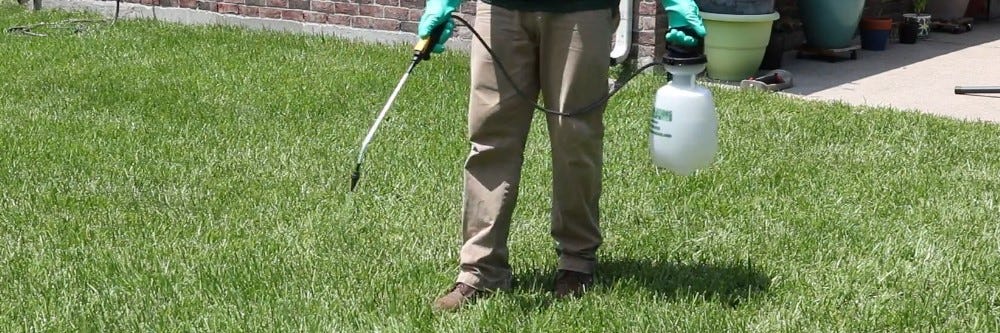
Use a fan or cone spray pattern to ensure the leaves are fully coated, and spray the weed to the point of wet but not runoff.
To minimize drift, be sure to spray on calm days when temperatures are not too hot and when wind speeds are low.
Step 2: Reapply if needed
 Since common lespedeza is a difficult weed to control, you may need to do a second application.
When appropriately applied, affected weeds will turn yellow and begin to die.
Reapply Fahrenheit Herbicide when 4-6 weeks have passed from the first treatment.
Triclopyr 4ec Herbicide can be reapplied to ornamental turf when at least 4 weeks have passed from the previous treatment. Do not treat turf if it is under heat or drought stress.
Prevention
Once common lespedeza has been eliminated from your property, you will need to implement preventative measures to ensure that it does not return.
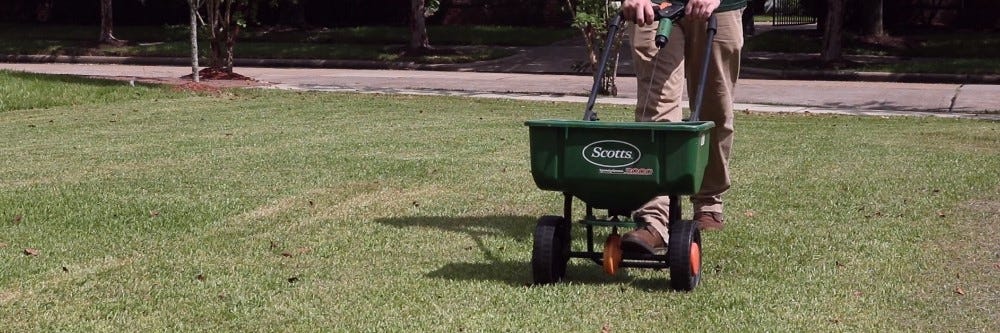
- The best strategy for preventing common lespedeza growth is to apply a pre-emergent herbicide. Applications during the early spring before soil temperatures reach 55 degrees Fahrenheit are best since this is when this weed is germinating. Dithiopyr 2EW Herbicide is liquid pre-emergent herbicide specially formulated to prevent annual grasses and broadleaf weeds, including common lespedeza in turf, landscape ornamentals, non-cropland sites, and more. Use 0.73 fl. oz. of Dithiopyr 2EW Herbicide with 1 gallon of water per 1,000 sq. ft. Broadcast the solution across the treatment area with a handheld or backpack sprayer. Once 6 hours have passed from application, you will need to irrigate the treated area with 0.5 inches of water.
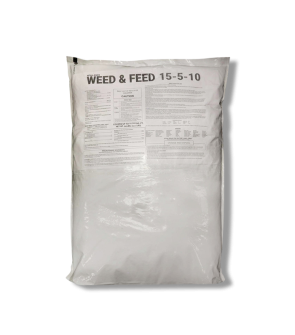
- Another good defense against common lespedeza is to maintain a healthy, dense lawn. It also wouldn't hurt to test your soil pH levels to see its nutrient levels as terrain with low-nitrogen are more susceptible to this weed. We recommend using Solutions 15-5-10 Weed & Feed with Trimec at a rate of 3.2 to 4.0 pounds of product per 1,000 sq. ft. of treatment area. Evenly distribute all of the granules throughout your treatment area. Do not wash from weed leaves for 1 to 2 days after application, and then thoroughly water the treated area after this time frame.
Key Takeaways
What is Common Lespedeza?
- Common lespedeza is a warm-seasoned annual legume that forms low-growing mats.
How to Get Rid of Common Lespedeza
- We recommend using Fahrenheit Herbicide or Triclopyr 4ec Herbicide to remove common lespedeza in your property.
Preventing Common Lespedeza Reinfestation
- To prevent common lespedeza, we recommend first applying a pre-emergent herbicide like Dithiopyr 2EW Herbicide. You will also need to keep up with regular lawn care practices such as mowing, watering, and seasonal applications of slow-release fertilizers.