

Gain access to personalized product screening, the best pricing, rewards, and more!
Create An Account, Or Sign In.
Most Effective Products
Black Medic Control: How to Get Rid of Black Medic
This page is a general black medic control guide. The suggested products and methods can control black medic in your property. Follow this guide and use the recommended products, and you will have 100% control over black medic.
You’ve probably seen it before, small, clover-like leaves and clusters of tiny yellow flowers spreading low across your lawn or garden bed. At first glance, black medic seems harmless, maybe even a little pretty. But this seemingly innocent plant often shows up uninvited, and once it settles in, it can be surprisingly stubborn.
Black medic goes by several other common names depending on the region. You might hear it called hop clover, yellow trefoil, black clover, black medic clover, black hay, nonesuch, or hop medic.
Black Medic is a cool-season annual or short-lived perennial legume that can be considered a weed due to its sprawling growth habit. Its sprawling growth habit allows it to quickly cover ground, crowding out desired grasses and plants. Because it spreads via seeds and can tolerate poor soil conditions, it is notoriously difficult to eradicate once established.
Many homeowners dislike the patchy, uneven appearance it creates, especially in manicured lawns. Additionally, its shallow roots don’t provide much soil stability, potentially making it less desirable in erosion-prone areas. With the information suggested throughout this DIY guide, you can find succesful tips and products to control and prevent black medic.
Identification
Before you can proceed with a treatment program, you must be sure that your weed is indeed black medic. Misidentification can lead you to use the wrong treatment products and waste time and money. Below are some characteristics of black medic to aid in identification:
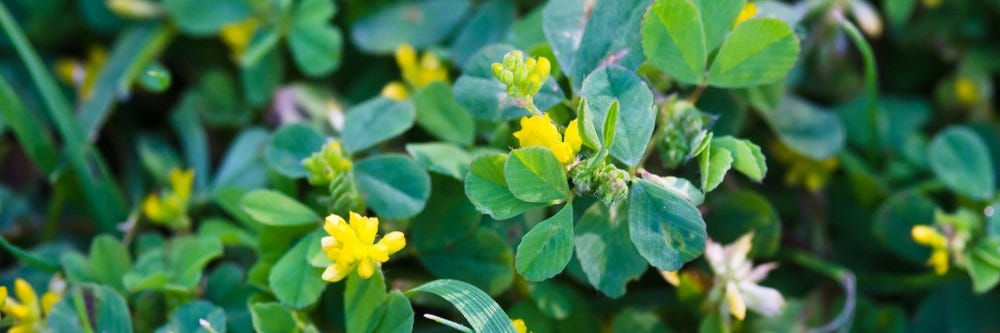
- Black medic is a low-growing, mat-forming weed with a sprawling habit that typically grows less than 12 inches tall and can spread 2 feet wide.
- This summer or winter annual broadleaf plant resembles clover due to its trifoliate (three-part) leaves, each leaflet being oval with a slight point at the tip and gently toothed edges. The leaves are typically medium to dark green. Each leaflet is 1 to 2 cm (2/5 to 7/10 inch) long. For clover, the leaflets are typically more rounded and lack a pointed tip.
- Black medic has branching stems near the base that grow prostrate or slightly upright, reaching up to 40 cm (1 1/3 feet) long. The plant is noticeably hairy, especially along the stems.
- From April to July, clusters of 10 to 20 small, yellow, pea-like flowers are formed in compact, rounded clusters approximately 5 to 6 mm in diameter. These clusters are known as inflorescences.
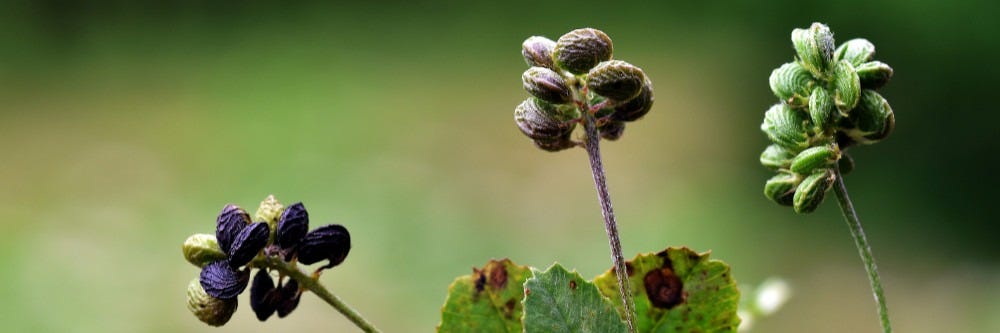
- After flowering, small kidney-shaped seed pods about 2 to 3 mm long develop and turn black as they mature, each containing a single seed. These smooth, yellowish-green seeds are oval to slightly kidney-shaped with a small sharp point and remain enclosed as the pods do not open.
Use the description above and the images to help you identify black medic on your property. If you are having trouble, contact us, and we will assist you in properly identifying your weed and offer suggestions.
Inspection
Once you have confirmed that you are dealing with black medic, you can proceed to inspection. During this phase, you will pinpoint the areas where the black medic is growing and observe the conducive conditions helping the weed to thrive. This will help you in determining where to focus your treatment applications.
Where to Inspect
Black medic is commonly found in a variety of disturbed and low-maintenance environments. It especially thrives in compacted or nitrogen-deficient soil.
You can find it in lawns, agricultural land, pastures, waste areas, vacant lots, construction sites, crop fields, grasslands, orchards, vineyards, gardens, roadsides, sidewalks, driveways, edges of fields, and other places where the soil has been disturbed or poorly managed.
What to Look For
One of the first signs is the presence of small, yellow, clover-like flowers that bloom in tight, rounded clusters, usually from spring through early fall. The plant grows low to the ground and spreads outward, forming trailing stems that often hug the soil surface.
In lawns, black medic usually stands out as darker green patches with a slightly different texture from the surrounding grass. As the plant matures, it produces small, black, spiraled seed pods, which are another clear indicator.
Black medic can cause areas, especially lawns or grassy fields, to appear thinner and patchier. Since it grows low to the ground and spreads outward rather than upward like grass, it doesn’t fill space in the same way, leading to a less dense appearance.
Treatment
Before handling any chemicals, ensure you have the right personal protective equipment for safety during mixing and application.
To control black medic, you will want to use selective post-emergent herbicide containing 2,4-D, dicamba, triclopyr, fluroxypyr, clopyralid, or MCPA.
Non-selective herbicides such as glyphosate can also be used, but will kill any vegetation they touch, so it should be applied carefully.
Step 1: Mix and Apply Herbicide
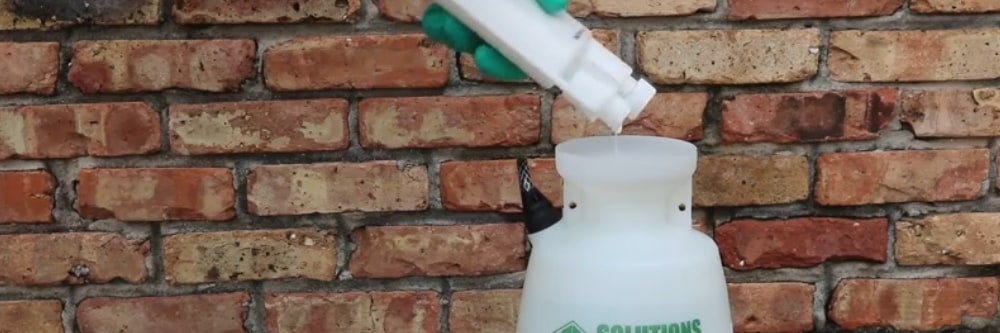
Determine how much herbicide to use by measuring the square footage of the treatment area. Find the square footage by measuring the treatment area's length and width in feet, then multiplying them together (length X width = square footage).
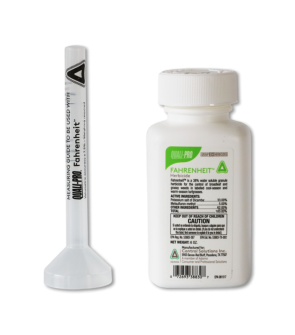
Fahrenheit Herbicide is a post-emergent weed killer that combines the active ingredients dicamba and metsulfuron-methyl to control broadleaf weeds and some grassy weeds in warm-seasoned turfgrass.
For spot applications with Fahrenheit Herbicide, mix 0.2 oz. of product per one gallon of water per 1,000 sq. ft.
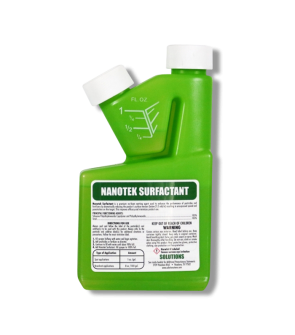
We suggest using a non-ionic surfactant such as Nanotek Surfactant to increase the herbicide's effectiveness against weeds like black medic.
Just add 1 fl. oz. of Nanotek Surfactant per 1 gallon of spray solution.
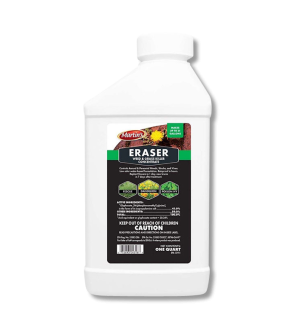
For other settings or smaller treatment areas, such as landscapes, concrete areas, and more, we suggest using Eraser 41% Glyphosate.
Eraser 41% Glyphosate is a non-selective post-emergent herbicide that will kill a wide range of weeds and unwanted vegetation. Keep in mind that it will kill any vegetation it comes in direct contact with during spraying.
For spot treatments with Eraser 41% Glyphosate, use 2 1/2 oz. (5 Tbs) of product per gallon of water to treat 300 sq. ft.
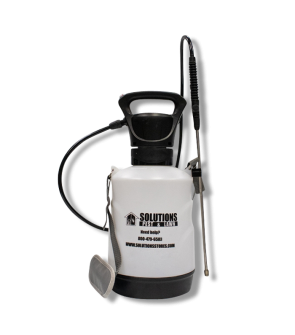
To use either of these products, you will need to mix with water in a handheld pump or backpack sprayer. It would be best to mark the sprayer for non-selective herbicide use only after spraying with Eraser 41 to avoid cross-contamination.
Spray the top and bottom of the weeds until wet, but not to the point of runoff.
Step 2: Reapply
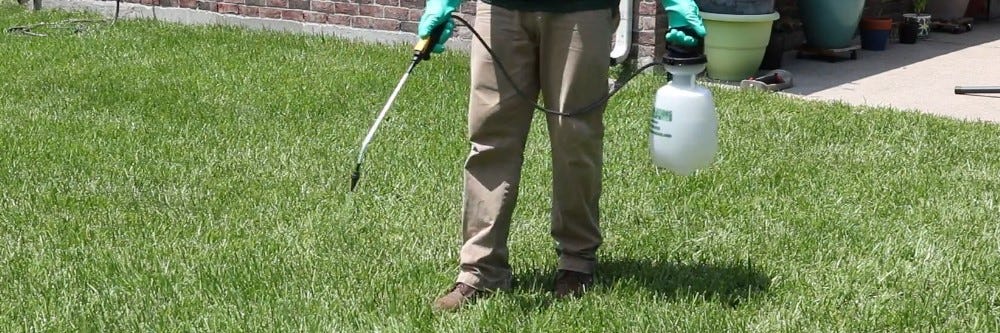
Weed growth ceases within hours after application of Fahrenheit Herbicide, resulting in control of weeds within 1 to 3 weeks after application.
Black medic will show initial symptoms in 2 to 4 days and complete kill in 1 to 2 weeks with Eraser 41% Glyphosate.
Black medic isn’t particularly hard to kill, but it can be persistent because it has a deep taproot and thrives in poor or compacted soils where grass struggles. For this reason, a second application is recommended.
Reapply Eraser 41% Glyphosate when 4 weeks have passed after the first application.
For Fahrenheit Herbicide, you may reapply when 4 to 6 weeks have passed after the first spraying.
Prevention
Once the black medic has been removed, take some preventative measures to ensure this weed does not return.
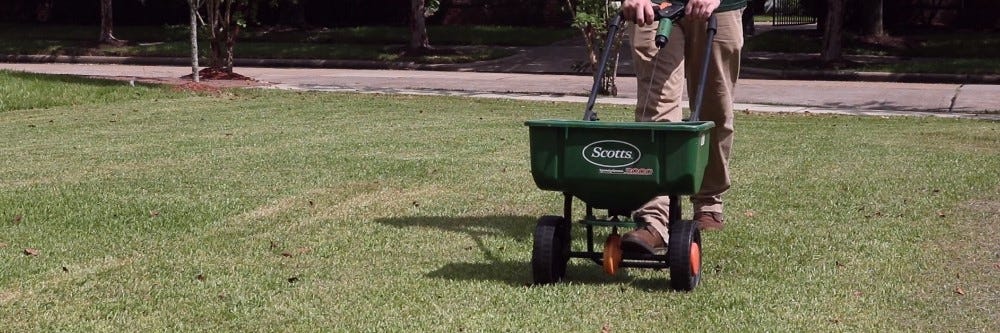
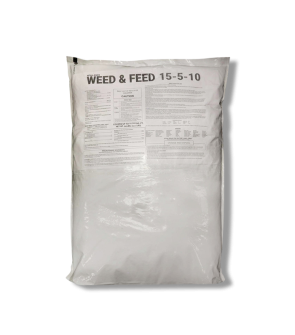
- Black medic tends to thrive in compacted, nitrogen-deficient soils, so improving soil health is key. Begin by regularly fertilizing your lawn with a balanced, slow-release nitrogen fertilizer to promote thick grass coverage. Solutions 15-5-10 Weed & Feed Fertilizer with Trimec is a unique fertilizer and weed killer combination that will slowly release essential nutrients to turf while eliminating emerged weeds such as black medic. You will need a push or broadcast spreader to use this product. Apply 3.2 to 4 pounds of Solutions 15-5-10 Weed & Feed Fertilizer with Trimec per 1,000 sq. ft. Broadcast half your granules at a perpendicular angle to cover the entire area. Do this by broadcasting the product, starting at the edge of the lawn and walking steadily around the yard's perimeter. Then, walk back and forth across the yard to cover the space in the middle. After 1 to 2 days, you can irrigate the treated area.
- Mowing your lawn at the proper height to shade the soil will help to reduce weed seed germination. Aerating compacted soil in the spring or fall improves root growth and drainage, making conditions less favorable for black medic growth.
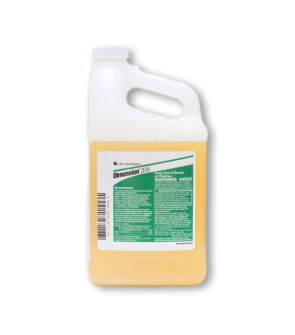
- In early spring, applying a pre-emergent herbicide such as Dimension 2EW Herbicide will help to prevent black medic from appearing. Dimension 2EW Herbicide is a selective pre-emergent herbicide concentrate that controls common broadleaf weeds in turf and ornamental landscapes. You will need a handheld pump sprayer or backpack sprayer to make applications. Apply 0.73 fl. oz. of Dimension 2EW Herbicide per 1 gallon of water per 1,000 sq. ft. Spray the entire area where you notice previous black medic activity or sites where you wish to prevent weed growth. Do not spray to the point of runoff. When 6 hours have passed after application, irrigate the treated area with 0.5 inches of water. You may reapply every 3 to 4 months, but do not exceed the maximum rate of 6 pints per acre per year or 2.2 fl. oz. per 1,000 sq ft per year.
Key Takeaways
What is Black Medic?
- Black medic is a low-growing broadleaf weed with clover-like leaves and small yellow flowers.
How to Get Rid of Black Medic
- To get rid of black medic, we suggest using Fahrenheit Herbicide or Eraser 41% Glyphosate. To increase your herbicide's effectiveness, a nonionic surfactant such as Nanotek Surfactant can be used.
Preventing Black Medic Reinfestation
- Black medic thrives in compacted, nitrogen-poor soils, so improving soil health is essential. Regularly fertilize with a balanced, slow-release fertilizer like Solutions 15-5-10 Weed & Feed with Trimec. Proper mowing height helps shade the soil and reduce weed germination, while aerating in spring or fall improves soil conditions to discourage black medic growth. In early spring, apply a pre-emergent herbicide like Dimension 2EW will help to prevent black medic. Reapply every 3 to 4 months if needed, without exceeding annual label limits.