


Gain access to personalized product screening, the best pricing, rewards, and more!
Create An Account, Or Sign In.
Most Effective Products
Hairy Bittercress Control: How to Get Rid of Hairy Bittercress
This page is a general hairy bittercress control guide. Using the products and methods suggested, you will get control of hairy bittercress. Follow this guide and use the recommended products; we guarantee 100% control of hairy bittercress.
Hairy Bittercress is one of the most persistent and fast-spreading winter annual broadleaf weeds that homeowners and gardeners will encounter. Depending on the climate, it can also act as a summer annual or biennial weed sometimes. Also known as bittercress, flick weed, hoary bittercress, lamb's cress, land cress, shot weed, springcress, or by its scientific name Cardamine hirsuta.
This resilient weed thrives in a wide range of conditions even cool, damp weather, allowing it to establish itself long before property owners notice it's there. One of the most unique features behind this foliage is its ability to shoot seeds several feet when the seed pods burst, ensuring quick and wider spread.
A single plant can produce up to 5,000 seeds, leading to dense, widespread infestation throughout the growing season. Even a small patch can reproduce rapidly and lead to dense patches that return year after year if not addressed. Hairy bittercress can be a relentless invader, but with the advice and recommended products in our DIY guide, you can stay ahead and effectively control this fast-growing weed.
Identification
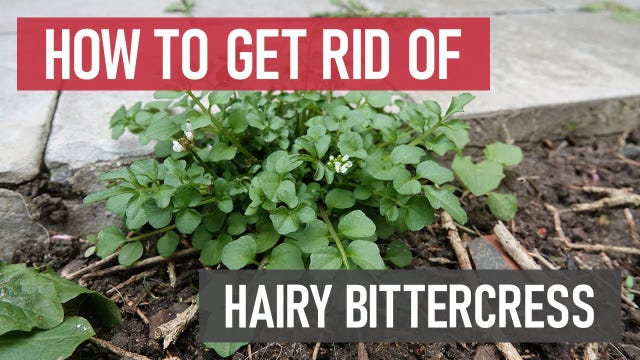
Before proceeding with a treatment program, you must be certain you are dealing with a hairy bittercress infestation. Careless identification can lead to using the wrong treatment methods, which can be a waste of time and money. Below are some common characteristics to help you understand what hairy bittercress looks like.
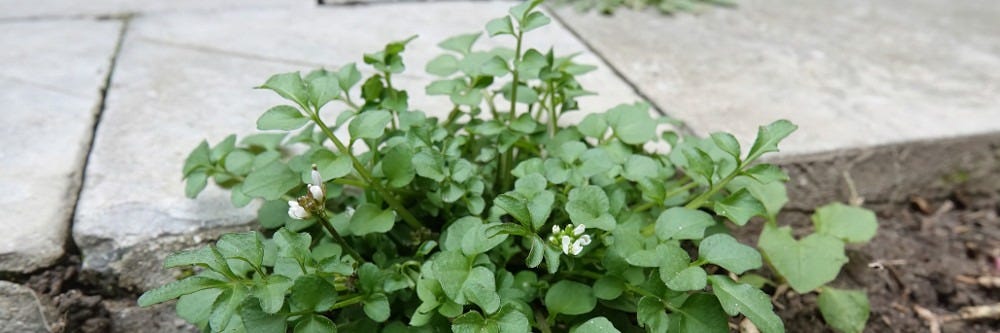
- Hairy bittercress, a small low-growing member of the mustard family (Brassicaceae), is an edible plant often regarded as a common weed. It forms a neat rosette of green leaves close to the ground during the fall and winter.
- The first true leaves are heart-shaped, followed by compound leaves made up of 2 to 4 pairs of round leaflets arranged alternately along a central stem, ending in a kidney-shaped terminal leaflet. Each leaf grows on a usually hairy petiole, with lower leaves only lightly hairy and upper leaves more distinctly so. The upper leaves are smaller and form clusters near the end of flowering stalks.
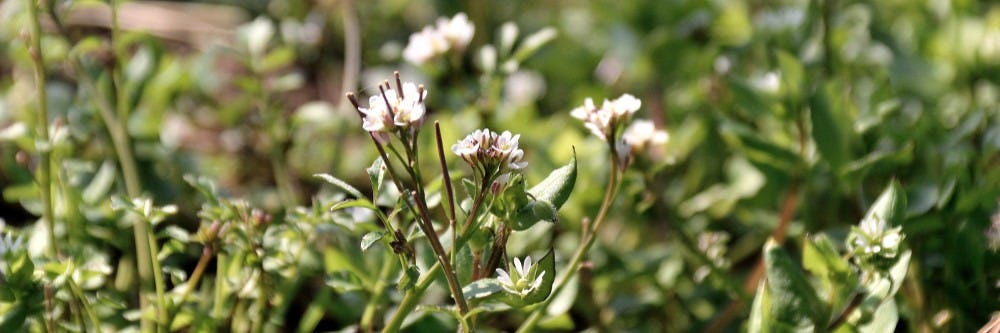
- As soon as conditions warm, hairy bittercress will produce flowers. Thin, fibrous flower stems emerge from the center of the rosette and grow 3 to 9 inches tall, ending in clusters of small white blossoms. Each flower is about 2 to 3 mm in diameter and has 4 white petals arranged in a cross shape, along with 4 sepals and typically 4 to 6 stamens. The flowers are arranged in dense racemes at the tips of stems and branch ends.
- As flowers mature, they develop into slender, flattened seed capsules (siliques) about 3/4 to 1 1/4 inches long, which dry and split open explosively when disturbed, launching seeds as far as 5 meters (16 feet) from the plant. Each seed pod contains up to 30 seeds.
Use the description and image above to help you properly identify hairy bittercress on your property. If unsure, contact us and send a photo of your weed through email or in person at one of our stores to help you identify the weed and suggest treatment options.
Inspection
Once confirmed that you are dealing with hairy bittercress, you can move on to inspection. During this phase, you will locate areas where hairy bittercress thrives and observe the conditions allowing it to thrive. This information will help you know where to focus your herbicide application.
Where to Inspect
Hairy bittercress favors cool, moist conditions and can grow in both full and partial shade, thriving particularly in nutrient-rich or well-drained soils, especially sandy soils.
This plant is commonly found in lawns, ornamental beds, landscapes, vegetable gardens, parks, paved areas (cracks in driveways or sidewalks), nurseries, container-grown plants, crops, greenhouses, and other moist, disturbed sites.
What to Look For
During the fall, hairy bittercress germinates and emerges as a basal rosette during the winter. The plant remains green throughout the winter, which allows it to produce flower stalks as soon as the weather warms up.
By late spring to early summer, this plant will die as it cannot survive in warmer weather.
Treatment
Once you have determined where hairy bittercress you can proceed with treatment, and be sure to wear the proper personal protective equipment (PPE).
Hairy bittercress is most effectively controlled when treatments target the weed early in its life cycle, either late in the fall as new seedlings emerge or in late winter to early spring while plants remain in the rosette stage. Applications made before the weed bolts and releases seeds provide the highest success rate.
Several herbicide active ingredients are effective on existing plants such as glyphosate, glufosinate, 2,4-D, dicamba, triclopyr, fluroxypyr, or carfentrazone.
Step 1: Mix and Apply Herbicide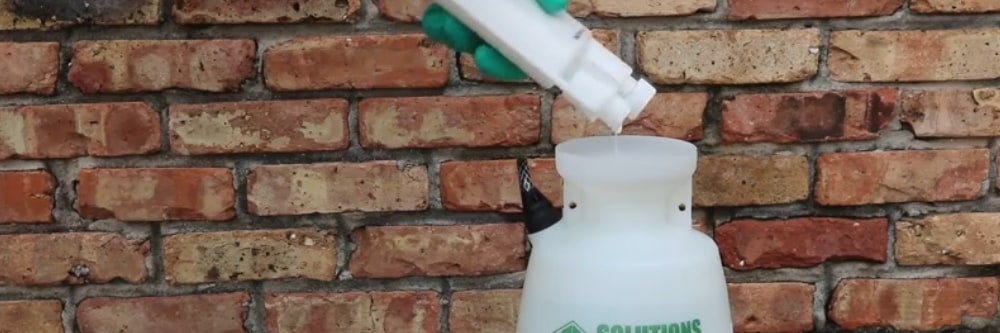
Determine how much herbicide to use by measuring the square footage of the treatment area. Find the square footage by measuring the treatment area's length and width in feet, then multiplying them together (length X width = square footage).
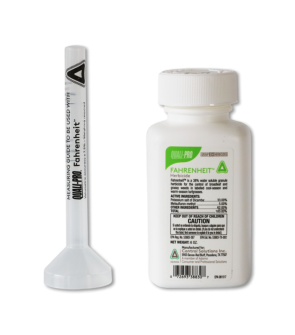
For properties with warm-seasoned turf we recommend Fahrenheit Herbicide. Fahrenheit Herbicide is an effective dicamba and metsulfuron-methyl based post-emergent herbicide that eliminates broadleaf and grassy weeds in warm-seasoned lawns.
For spot applications, mix 0.2 oz. of Fahrenheit Herbicide per 1 gallon of water per 1,000 sq. ft.
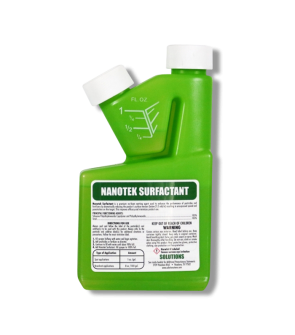
To enhance this product’s efficacy, mix in a surfactant like Nanotek. Nanotek is a non-herbicide product designed to improve the adhesion and penetration of pesticides onto treated surfaces.
Just add 1 fl. oz. of Nanotek Surfactant per 1 gallon of solution.
For properties with cool-seasoned turf, you can use 1/4 pint of 2,4-D Amine Selective Post-Emergent Herbicide in 3 gallons of water.
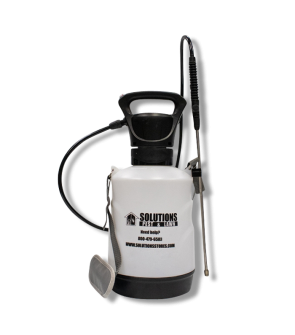
You will need to mix either of these herbicides in a handheld pump sprayer or backpack sprayer.
Adjust your sprayer to a fan or cone nozzle setting before application. Next, treat the top and bottom of weed leaves until wet, but not to the point of runoff.
When using 2,4-D Amine Selective Post-Emergent Herbicide avoid applications when temperatures are above 90 degrees Fahrenheit.
For Fahrenheit Herbicide, be aware that spot treatments during temperatures above 85 degrees Fahrenheit may cause temporary growth reduction of St. Augustinegrass.
Step 2: If Needed, Retreat
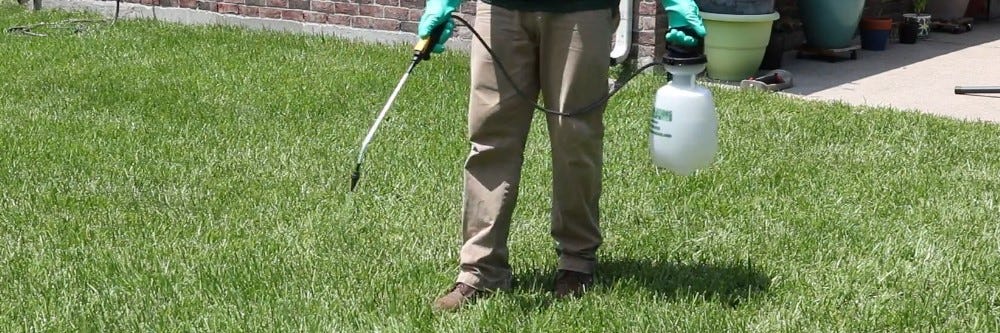
When applied properly, affected weeds will yellow and begin to die. Conduct follow-up applications as necessary.
A repeat application with Fahrenheit Herbicide can be made when 4 to 6 weeks have passed after application.
Reapplications can be made with 2,4-D Amine Selective Post-Emergent Herbicide when 30 days have passed after application.
Prevention
Once you’ve cleared your property of hairy bittercress, you’ll need to adopt prevention practices to stop it from reestablishing. Here are common preventative measures you can take:
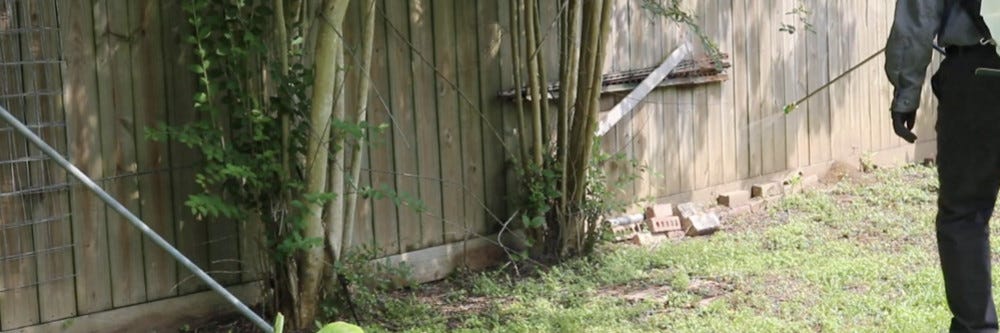
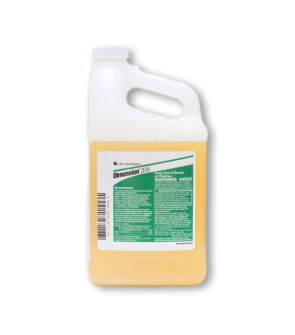
- For prevention of new hairy bittercress infestations, pre-emergent herbicides applied in late summer through early fall can significantly reduce germination: products containing isoxaben, prodiamine, pendimethalin, or dithiopyr are particularly effective for suppressing hairy bittercress seedlings before they emerge. Dimension 2EW Herbicide is a pre-emergent herbicide concentrate containing dithiopyr that prevents broadleaf and grassy weeds, including bittercress, from germinating in established lawns, container-grown ornamentals, landscapes, and more. You will need to use 0.73 fl. oz. of Dimension 2EW Herbicide per 1 gallon of water per 1,000 sq. ft. With a backpack sprayer or handheld pump sprayer, spray the entire area you wish to prevent hairy bittercress or where previous infestations were present. Once 6 hours have passed after application, irrigate the treated area with 0.5 inches of water. You may reapply every 3 to 4 months, but do not exceed the maximum rate of 6 pints per acre per year or 2.2 fl. oz. per 1,000 sq. ft. per year.
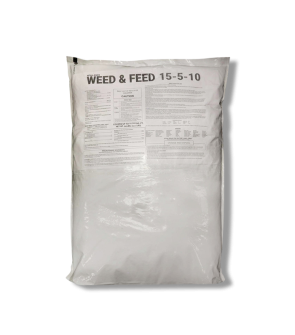
- Keeping your lawn thick and healthy is also important, since dense turf prevents hairy bittercress from establishing. For lawn strengthening and weed suppression, we suggest using Solutions 15-5-10 Weed & Feed Fertilizer with Trimec. This product will feed the lawn while targeting emerged weeds, helping to create a turf environment that naturally suppresses bittercress. Applications are best made during the early spring. You can also use Solutions 15-5-10 during the late winter if that's the appropriate time of growth for your turf. Apply 3.2 to 4 pounds of Solutions 15-5-10 Weed & Feed Fertilizer with Trimec per 1,000 sq. ft. Spread the granules evenly across the treatment area. Do not water the granules in until 1 to 2 days have passed after application.
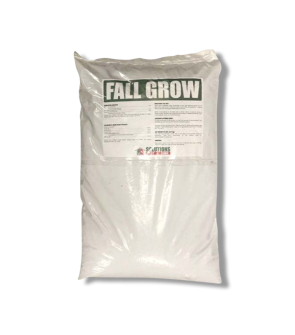
- We also recommend using a fall fertilizer like Solutions 8-12-16 Fall Grow Fertilizer since it will better prevent bittercress during the winter. Solutions 8-12-16 Fall Grow Fertilizer should be applied in the fall, typically from September to mid-October. Be sure that the frost in your region is not expected to occur within the next 2 to 3 weeks. Apply 5 pounds of Solutions 8-12-16 Fall Grow Fertilizer per 1,000 sq. ft. Start by broadcasting the fertilizer along the edges of your lawn. This ensures that the perimeter is evenly covered, which is important because edges are often missed and can become weak spots where weeds like hairy bittercress can establish. After completing the edges, move back and forth across the main area of the lawn in overlapping passes to ensure complete and even coverage. Once the fertilizer has been applied, water the lawn thoroughly.
- Hand-pulling or using a garden hoe or garden shovel to remove hairy bittercress rosettes is another method, though it is more labor. Plants should be removed immediately once they begin to flower, or flower stalks can be cut back or mowed to prevent seed production.
- Mowing can also serve as a preventative measure, but it must be done frequently in early spring to remove the tiny white flowers before they develop explosive seed pods. If there are flowers or seeds on hairy bittercress, we suggest avoiding mowing until the weed has been removed to prevent spreading it further into your property.
- Be sure to maintain regular watering of property when turf is actively growing. Water with no more than 1-inch of irrigation once per week. Watering will help to encourage thicker and healthier turf growth that will choke out hairy bittercress.
Key Takeaways
What is Hairy Bittercress
- Hairy bittercress is a fast-growing, low-growing winter annual weed that produces small white flowers and explosive seed pods.
How to Get Rid of Hairy Bittercress
- To kill hairy bittercress, use Fahrenheit Herbicide or 2,4-D Amine Selective Post-Emergent Herbicide. We also suggest using a non-ionic surfactant like Nanotek Surfactant to aid in control.
Preventing Hairy Bittercress Reinfestations
- To prevent hairy bittercress, apply Dimension 2EW Herbicide in late summer to early fall to stop seed germination, and maintain a thick, healthy lawn with proper fertilization and regular watering to naturally suppress weeds. Hand-pulling young rosettes before flowering, cutting back or mowing flower stalks in early spring, and applying season fertilizers like Solutions 15-5-10 in early spring and Solutions 8-12-16 in fall further strengthen turf and reduce weed establishment. Frequent early spring mowing before seed pods form also helps prevent reseeding and spread.