


Gain access to personalized product screening, the best pricing, rewards, and more!
Create An Account, Or Sign In.
Most Effective Products
Kochia Control: How to Get Rid of Kochia
This page is a general kochia control guide. The suggested products and methods can control kochia in your property. Follow this guide and use the recommended products, and you will have 100% control over kochia.
Kochia, also known as summer cypress, Mexican fireweed, fireweed, tumbleweed, burning-bush, belvedere, fireball, belevedere, broom-cypress, red belvedere, belevedere-cypress, red belevedere, or mock cypress is an annual broadleaf weed that grows rapidly. While its bright red foliage in the fall makes it attractive to some gardeners as an ornamental, it quickly becomes invasive and difficult to control once established.
With its ability to germinate at low temperatures, this troublesome weed can germinate at any point in the season and create a large number of seeds, often above 14,600 per plant. This rapid growth and prolific production of seeds make kochia particularly aggressive and difficult to control for the average property owner.
Adding to the challenge of this drought-tolerant plant, many kochia species have developed herbicide resistance to various chemicals. Additionally, kochia has dense, waxy leaves that make it harder for herbicides to penetrate. If implemented soon enough with the tips and products in our DIY guide, kochia infestations can be effectively controlled before they spread and cause major damage.
Identification
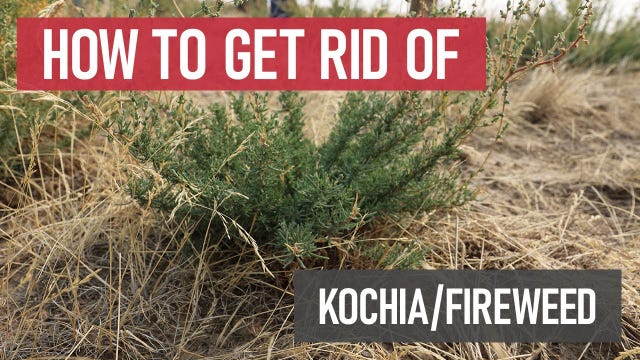
Before you can proceed with a treatment program, you must be sure that your foliage is indeed kochia. Misidentification can lead you to use the wrong treatment products and waste time and money. The following traits listed below can help identify kochia:
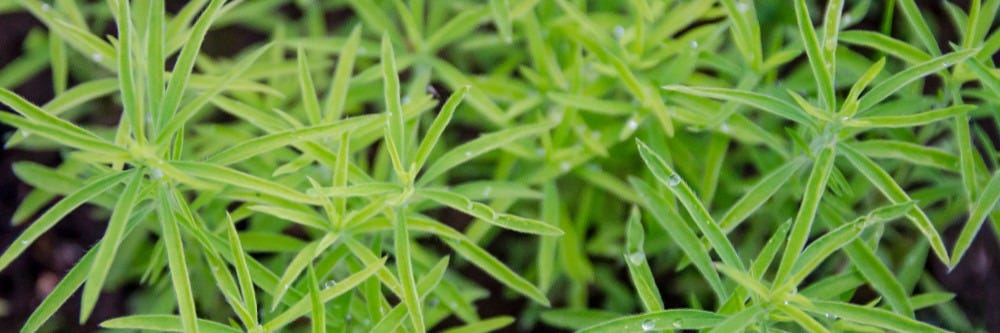
- Kochia is a tall, upright summer annual broadleaf weed that can reach up to 5 feet in height and has many branches spreading from its base.
- Its stems are round and often develop a reddish tint as the plant ages. The leaves change shape as the kochia grows: young plants have wider, ovate leaves up to 2.5 inches long that sit directly on the stem, while mature plants have narrower, linear leaves about 1 inch long. The leaves are arranged alternately along the stem and have smooth edges with fine hairs, sometimes showing three noticeable veins. The color of the leaves ranges from blue-green to gray-green.
- From July to October, this plant will produce inconspicuous flowers that have no petals and are small, green, and grow in clusters where the leaves meet the stem, as well as at the ends of branches. These flower clusters form spikes that have soft hairs.
- Seeds are 1.5 millimeters long and are wedge-shaped with a light brown color. They develop inside small, star-shaped fruits that are flattened and brown. Each flower produces a tiny, inflated seed-bearing structure that is enclosed by the sepals, protecting the seeds as they mature.
- Kochia seedlings initially have thick, dull green leaves with a subtle magenta tint on the underside. At this early stage (known as the button stages in the first two weeks of emergence), the leaves are densely covered with fine white hairs. About two weeks after they emerge, the leaves grow larger and less hair is seen. After this stage, the tops of leaves become smooth, while the underside retains fine hairs, giving the plant a slightly fuzzy feel underneath. As the plant matures, it develops more branches, especially near the base.
- At the end of its life cycle, kochia dries out and breaks off at the base, becoming a tumbleweed. As a tumbleweed, it's dry, round, and is a bushy ball of stems and branches. The dried stems and leaves take on a reddish or brownish hue.
Use the description above and the images to help you identify kochia on your property. If you are having trouble, contact us, and we will assist you in properly identifying your unwanted foliage and offer suggestions.
Inspection
Once you have confirmed that you are dealing with kochia, you can proceed to inspection. During this phase, you will pinpoint the areas where the kochia is growing and observe the conducive conditions helping the plant to thrive. This will help you in determining where to focus your treatment applications.
Where to Inspect
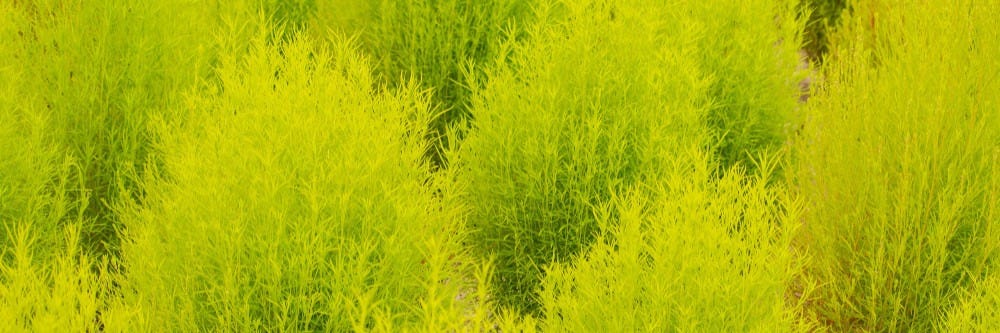
Kochia is a highly invasive weed that's able to grow in harsh conditions where other plants cannot, such as poor soil conditions, drought, and sites with high temperatures. Often, it's seen in dry, open environments with well-drained soils.
Common sites for kochia to be found in are pastures, rangelands, roadsides, ditchbanks, wastelands, crops, cultivated fields, seasonal wetlands, agricultural fields, and areas where the soil has high salinity.
What to Look For
Kochia begins to germinate very early in the spring when soil temperatures rise above 40 degrees Fahrenheit. Because kochia can germinate at low temperatures, seedlings can start emerging as early as January in some areas and continue to appear throughout the summer, often until July.
After the plant matures and dries out (usually in late summer or early fall), its stems become brittle, and the entire above-ground part of the plant breaks off near the base, turning it into a tumbleweed.
Treatment
Before handling any herbicides, be sure to wear the proper personal protective equipment (PPE) as instructed on your product's label for safety during mixing and application.
Since kochia has a wide window of emergence, we recommend it be managed from early spring through late summer to effectively control new growth.
Some species of kochia show resistance to the active ingredients sulfonylureas, triazines, atrazine, glyphosate, and dicamba. If you find that kochia is still present after your herbicide application, you may have a resistant species and will need to switch to another herbicide with a different active ingredient.
Step 1: Mix and Apply Herbicide
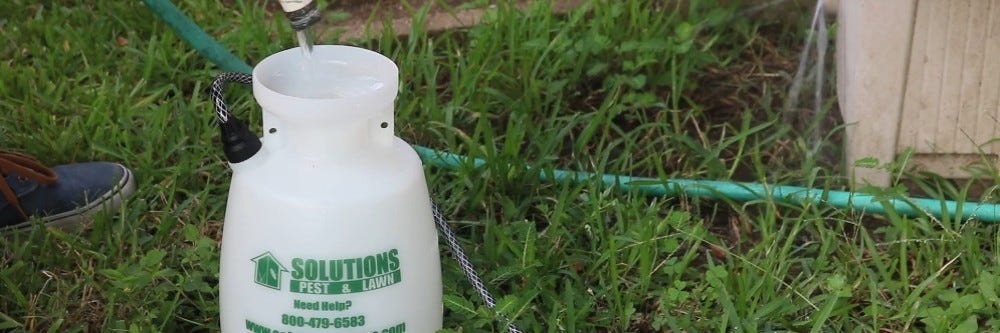 Determine how much herbicide to use by measuring the square footage of the treatment area. Find the square footage by measuring the treatment area's length and width in feet, then multiplying them together (length X width = square footage).
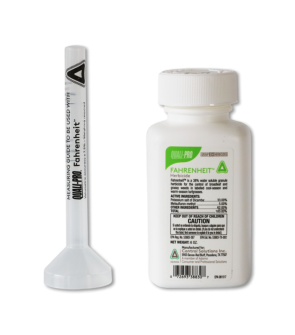
Fahrenheit Herbicide, which contains dicamba and metsulfuron-methyl, is a post-emergent herbicide that targets a wide range of broadleaf and grassy weeds in warm-seasoned turf.
For spot treatments with Fahrenheit Herbicide, mix 0.2 oz. of product per 1 gallon of water per 1,000 sq. ft.
2,4-D Amine Selective Post-Emergent Herbicide is an effective systemic herbicide concentrate that controls emerged broadleaf weeds and brush in pastures, rangelands, non-crop areas, and other turf sites.
A spot application with 2,4-D Amine Selective Post-Emergent Herbicide will use 1/4 pint of this product in 3 gallons of water.
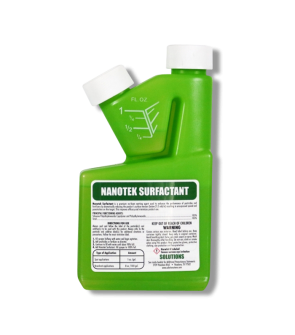
To enhance the effectiveness of your herbicide application, add a surfactant such as Nanotek at a rate of 1 fluid ounce per gallon of solution.
Nanotek is a non-herbicidal additive that improves spray adhesion and penetration, helping the herbicide spread evenly and absorb more effectively through kochia’s dense, waxy foliage for enhanced control.
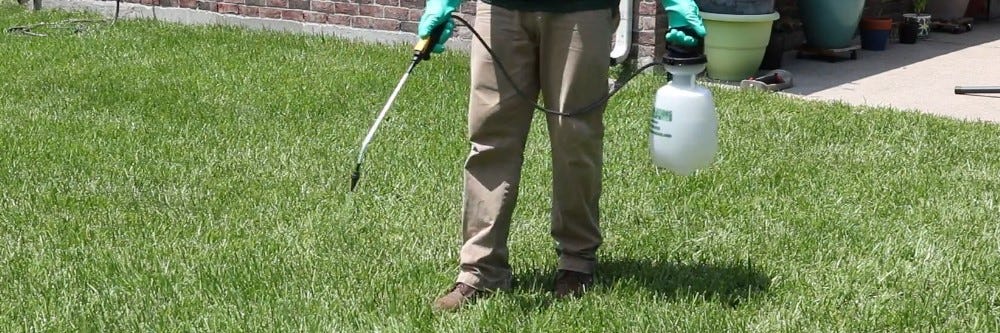
For either of these products, you will need to mix with water in a handheld pump sprayer or backpack sprayer.
Spray the top and bottom of weed leaves until wet, but not to the point of runoff.
Keep people and pets away from treated areas for 24 hours after applying Fahrenheit Herbicide.
After 2,4-D Amine Selective Post-Emergent Herbicide application, you will need to keep people and pets away from treated areas until 48 hours have passed after application.
Step 2: Reapply
 With proper application, you will notice treated weeds start to yellow and fade within a short time. If any stubborn plants hang on, just follow up with another application.
You can reapply Fahrenheit Herbicide after 4 to 6 weeks have passed from the first application.
Similarly, 2,4-D Amine Selective Post-Emergent Herbicide can be used again 21 to 30 days after the initial treatment to manage any surviving or new weeds.
If kochia keeps coming back despite follow-up treatments, try rotating to a herbicide that contains different active ingredients and mode of action to get better results and reduce the risk of resistance.
Prevention
After removing the kochia, it is important to implement preventative measures to discourage its regrowth. The following techniques can aid in this effort:
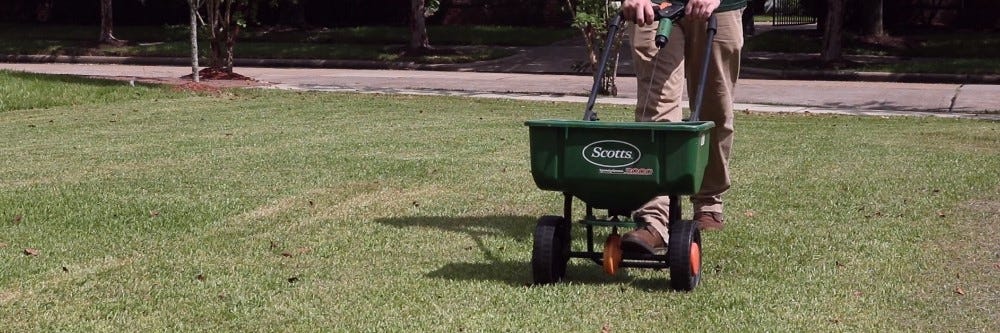
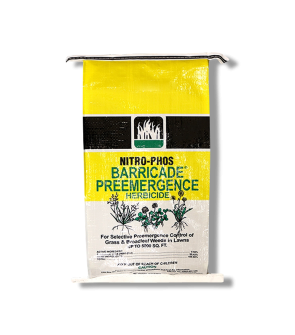
- One of the most effective ways to prevent kochia is to kill weeds before they emerge with a pre-emergent herbicide like Barricade. Barricade Pre-Emergent Herbicide is an effective pre-emergent granule herbicide that stops weeds from germinating underneath the soil in turf and ornamental landscapes before they emerge. It will need to be applied with a handheld spreader, push spreader, or broadcast spreader. Depending on your turf species, apply 1.5 to 4 pounds of Barricade Pre-Emergent Herbicide per 1,000 sq. ft. For landscape ornamentals, use 2.5 to 5.94 lbs. of product per 1,000 sq. feet. Calibrate the spreader to the proper setting and load the correct amount of granules. Spread the herbicide by making two perpendicular passes. To activate the herbicide, water the granules in with 0.5 inches of water. The best windows for application for Barricade are typically spring and fall, when the turf is actively growing. An additional application may be made after 6 months for year-round weed prevention.
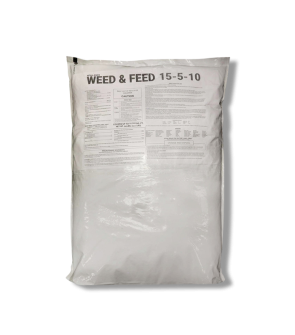
- In addition to applying a pre-emergent, we also recommend common cultural practices such as mowing and fertilization to encourage thick turf growth. Dense turf growth and thick crop canopies make it much harder for kochia to become established and grow, as they limit sunlight and space needed for kochia seedlings to grow. A fertilizer such as Solutions 15-5-10 Weed & Feed Fertilizer with Trimec would work. It is a unique combination of a slow-release granule fertilizer and post-emergent herbicide that feeds turf and kills emerged weeds. You will need 3.2 to 4 pounds of Solutions 15-5-10 Weed & Feed Fertilizer with Trimec per 1,000 sq. ft. Spread the granules evenly across your turf. After 1 to 2 days of application, you can then thoroughly water the granules in for them to be activated.
- Rotate crops each season to disrupt kochia and reduce the chances of repeated infestations.
- Regularly clean tractors, mowers, and other tools used to manage your property to prevent spreading weed seeds.
Key Takeaways
What is Kochia?
- Kochia is an annual broadleaf weed known for its rapid growth. After dying, it transforms into a tumbleweed, which helps spread seeds and infest other areas of the property more easily.
How to Get Rid of Kochia
- Effective control of kochia begins with an application of Fahrenheit Herbicide or 2,4-D Amine Selective Post-Emergent Herbicide mixed with Nanotek Surfactant.
Preventing Kochia Reinfestation
- To prevent kochia, we suggest using Barricade Pre-Emergent Herbicide and maintaining thick, healthy turf through proper mowing and fertilization with Solutions 15-5-10 Weed & Feed Fertilizer with Trimec. Additional practices such as crop rotation and regularly cleaning equipment help to reduce the odds of spreading the seeds.