

Gain access to personalized product screening, the best pricing, rewards, and more!
Create An Account, Or Sign In.
Most Effective Products
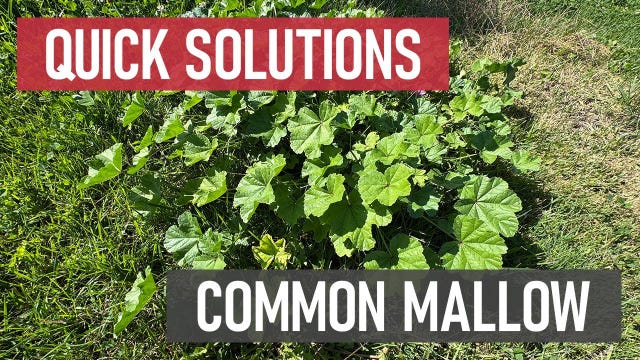
Common Mallow: How to Get Rid of Common Mallow
This page is a general common mallow control guide. Using the products and methods suggested in this DIY article will help you get control of common mallow. Follow this DIY guide and use the recommended products and we guarantee 100% control of common mallow.
Common mallow is a broadleaf weed also known as buttonweed, cheeseplant, cheeseweed, dwarf mallow, roundleaf mallow, running mallow, malice, round dock, or low mallow. This plant comes from the mallow family of plants, which are known for a number of desirable foliage. But, do not let this fool you as common mallow is far from a desirable foliage.
The common mallow is actually an invasive weed that easily grows in a number of soil types and chokes out other plants for space, water, sunlight, and nutrients. Common mallow grows from a thick, straight taproot and can produce a large number of seeds in a short amount of time.
Let's learn more about common mallow, its characteristics, and how to control and prevent it with the helpful tips and products in this article.
Identification
Before proceeding with a treatment program, you will need to determine if the weed on your lawn is common mallow. Misidentification can lead you to using the wrong treatment method, which can be a waste of time and money. Refer to the following characteristics to help you identify common mallow.
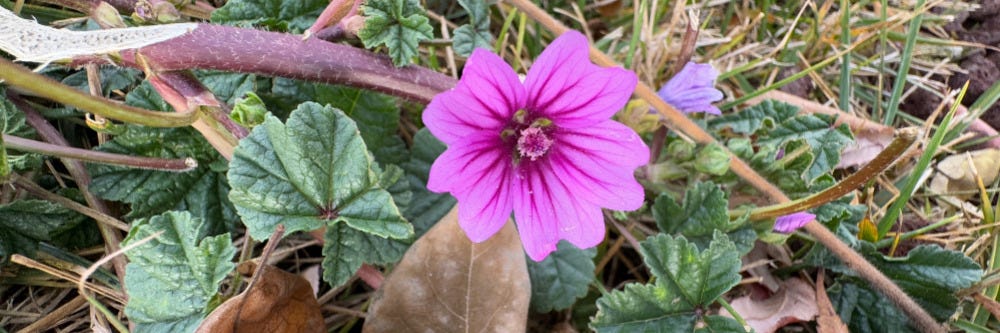
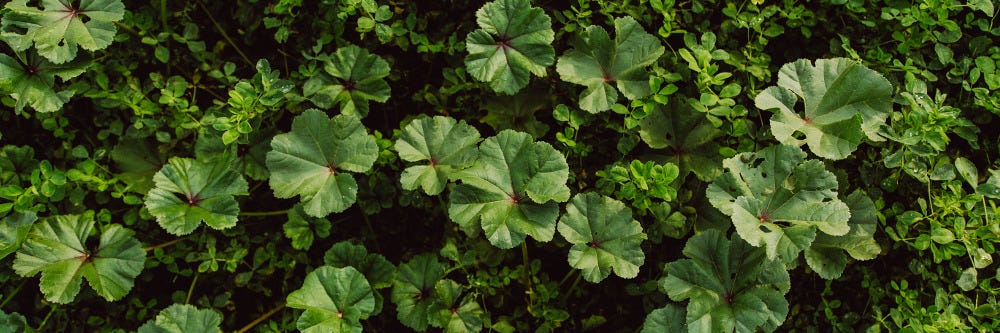
- Common mallow is a low-growing annual or winter biennial broadleaf weed that can have an erect or decumbent growth habit with stems up to 2 ft. long. Young plants grow as a basal rosette.
- The leaves are alternately arranged, dark green to purple in color, kidney to heart-shaped with three main veins, and have long, slender petioles. The stems and leaves have short hairs. The edges of leaves are crinkled in appearance with rounded margins and obscurely lobed.
- At the end of each stalk from late spring to fall you will find flowers. The flowers are either white, light pink, light lavender, or pinkish-lavender in color with dark veins running up each petal. There are five flower petals each with notched tips.
- Eventually, you will find fruits near the base of the petals. These fruits resemble a small button or wheel of cheese with 13-15 segments, each one contains a seed.
- Another weed common mallow is commonly mistaken for is ground ivy. However, there are a few ways to tell them apart. The main difference is the shape and arrangement of the leaves. Ground ivy has square stems and leaves that attach in the center of the leaf whereas common mallow leaves are attached to the stem at the back and have more rounded edges.
Use the description and image above to help you identify common mallow on your lawn. If you are unsure whether the plant is common mallow, then contact us with a photo of the weed and we will properly identify the foliage and suggest the appropriate herbicide recommendations.
Inspection
After you have confirmed that the infestation on your property is common mallow, you can proceed with inspection. During this phase, you will locate areas where common mallow is thriving and observe the conditions helping that are allowing it to survive. This information will help you in knowing where to focus your herbicide applications.
Where to Inspect
Common mallow often grows in an area with disturbed soil and sites with little competing foliage.
Commonly this weed is found in waste grounds, footpaths, meadows, roadsides, lawns, gardens, croplands, and open areas with little competing foliage.
What to Look For
Typically, common mallow takes on a low-growing spreading form throughout the spring, summer, and fall.
Depending on where you live, flowers will bloom from April to May and through October.
During a drought, you may find a leafless vine. As the weed matures it will develop a long, woody taproot.
Treatment
When beginning any weed control application, you will need to wear the appropriate personal protective equipment (PPE) that protect your face, mouth, eyes, hands, feet, and skin.
The most effective herbicides for controlling common mallow should contain the active ingredient 2,4-D, dicamba, or triclopyr.
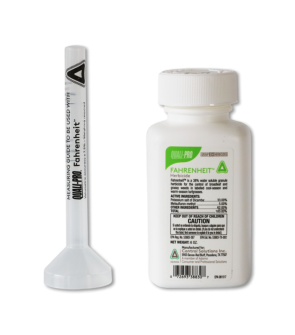
To control common mallow in warm-seasoned turf, we suggest Fahrenheit Herbicide. Fahrenheit Herbicide is a water-soluble granule herbicide designed for post-emergent control over various broadleaf and grassy weeds.
To control common mallow in cool-seasoned turf, your best option is 2,4-D Amine Selective Post-Emergent Herbicide. This post-emergent herbicide is an emulsifiable concentrate that successfully eliminates many broadleaf and grassy weeds.
Step 1: Mix and Apply Herbicide
 Determine how much herbicide to use by measuring the square footage of the treatment area. Find the square footage by measuring the treatment area's length and width in feet, then multiplying them together (length X width = square footage). For acreage, take the square footage and divide it by one acre (square footage / 43,560 sq. ft. = acres).
For spot treatments with Fahrenheit Herbicide, use 0.2 oz. of product with 1 gallon of water to cover 1,000 sq. ft. of turf.
Spot treatments with 2,4-D Amine Selective Post-Emergent Herbicide will use 1/4 pint of this product in 3 gallons of water.
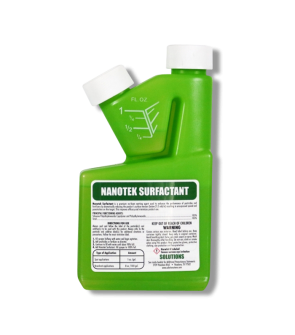
We recommend using Nanotek Surfactant as well during your herbicide applications. Nanotek is a non-herbicide product designed to improve the adhesion and penetration of pesticides onto treated surfaces.
To use Nanotek Surfactant, add 1 fl. oz. per 1 gallon of solution.
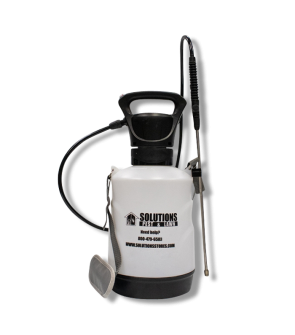
These products will need to be mixed with water in a handheld or backpack sprayer.
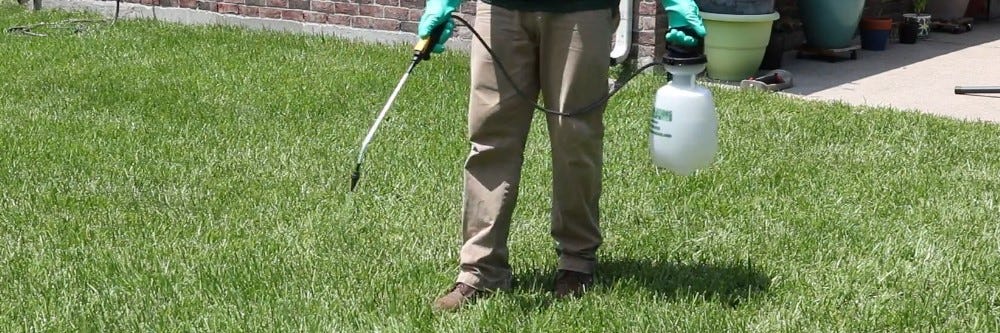
To mix, fill the sprayer tank with half the amount of water. Add in the proper amount of herbicide and Nanotek Surfactant. Lastly, pour in the remaining half of water and shake the tank until well-mixed.
During application, adjust the sprayer nozzle to a fan-spray setting so it will spray a fine mist on the top and bottom of the cocklebur leaves. Spray to the point of wet, but not runoff.
Avoid applications with Fahrenheit Herbicide when the weather is above 85 degrees Fahrenheit.
Do not apply 2,4-D Amine Selective Post-Emergent Herbicide when the weather is above 90 degrees Fahrenheit.
Keep in mind that when making applications over St. Augustinegrass, Bermudagrass, or Zoysiagrass, temporary stunting or chlorosis may occur.
Step 2: Reapply if needed
 After application, treated weeds will turn yellow and die.
Mature stages of common mallow can be difficult to control, especially if it has an extensive taproot system. For this reason, a second application may be needed.
A second application with Fahrenheit Herbicide can be done when 4-6 weeks have passed from the first treatment.
Reapplication with 2,4-D Amine Selective Post-Emergent Herbicide ranges from 21 to 30 days.
Prevention
After you have treated common mallow from your property, you will want to ensure this weed does not return. Common mallow can be more quickly controlled when proper cultural practices are used when the weed is still young and in combination with an approved herbicide. Take on the following preventative measures to keep this deep-rooted weed from reestablishing.

- The best way to prevent common mallow is to keep up with regular turf maintenance. Manually hand-pulling the weed can be done, but if any part of the plant is left over it can regrow. For this reason, hoeing, tilling, or hand-pulling should be done when the weed has less than four leaves and when they are flowerless.
- Mow your turf to the appropriate height and water deeply to encourage healthy turf growth. Water with no more than 1 inch of irrigation once per week, preferably in the early morning. If common mallow is present avoid mowing over it as this can only spread the infestation further into your property.
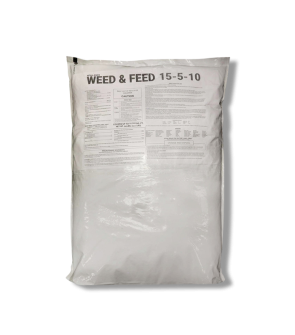
- Encourage thicker turf with seasonal fertilization with a slow-release granule fertilizer. We recommend granular slow-release fertilizers because they provide a gradual and consistent supply of nutrients over the season. Consider applying a fertilizer like Solutions 15-5-10 Weed & Feed with Trimec. This product is a slow-release fertilizer that will provide lawns with essential nutrients and fight against weed development. Mow lawn to normal height 1 to 2 days before application. Water the lawn thoroughly at least 1 day before application to sustain moisture until the next watering. If the grass is not moist at the time of application, sprinkle lightly with water to hold the material. With a push or broadcast spreader, apply 3.2 to 4 pounds of Solutions 15-5-10 Weed & Feed with Trimec per 1,000 square feet. Do not wash from weed leaves for 1 to 2 days after application. At this time, a thorough watering should be made.
Key Takeaways
What is Common Mallow?
- Common mallow is a low-growing, branching vine with tough stems and a deep taproot that helps this broadleaf weed survive more easily.
How to Get Rid of Common Mallow
- To control common mallow you will need to use Fahrenheit Herbicide or 2,4-D Amine Selective Post-Emergent Herbicide depending on your turf type.
Preventing Common Mallow Reinfestation
- To prevent common mallow, you will need to ensure your turf stays thick and healthy since this weed invades areas with little competing foliage growth and disturbed soil. You can maintain your turf health with regular mowing, watering, and fertilization.