

Gain access to personalized product screening, the best pricing, rewards, and more!
Create An Account, Or Sign In.
Most Effective Products
Yarrow Control: How to Get Rid of Yarrow
This page is a general yarrow control guide. Using the products and methods suggested in this DIY article will help you get control of yarrow. Follow this DIY guide and use the recommended products and we guarantee 100% control of yarrow.
While some homeowners consider yarrow a beautiful wildflower others may view it as a fast-growing perennial broadleaf weed. Depending on where you live, this weed goes by many names such as milfoil, thousandleaf, soldiers woundwort, bloodwort, nose bleed, devils nettle, sanguinary, old-man's-pepper, stenchgrass, common yarrow, or western yarrow.
This plant is an excellent source of nectar for pollinating insects like bees, but there is also risk with keeping yarrow in your property. The most significant risk is that it can be toxic to your pets and cause skin rashes for people.
If you leave yarrow to spread in your garden or other parts of your property expect to see a thick mass of stems and leaves. It will go anywhere where there is open space resulting in the death of other nearby foliage.
Once you have noticed yarrow on your property, you should begin control immediately with the recommended tips and products in our DIY guide.
Identification
Before proceeding with a treatment program, you will need to determine if the weed on your lawn is yarrow. Misidentification can lead you to using the wrong treatment method, which can be a waste of time and money. Refer to these following characteristics to help you identify yarrow.
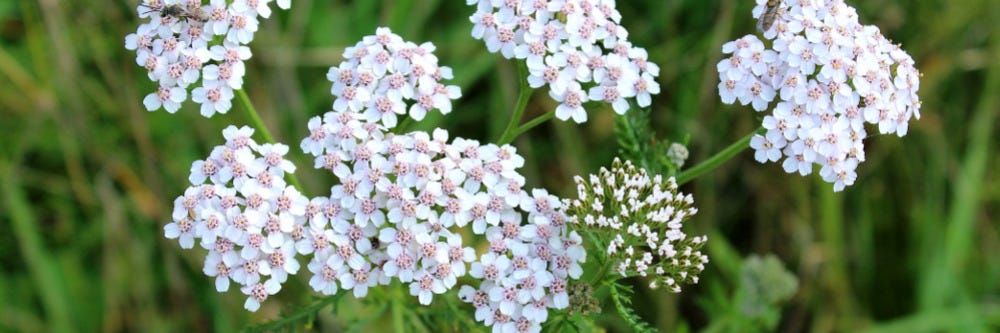
- Yarrow is a perennial broadleaf weed with finely divided and feather-like leaves that grows up to 2.5 feet tall. When young, yarrow grows in a rosette arrangement. Once it flowers, it can grow about 3 feet in height.
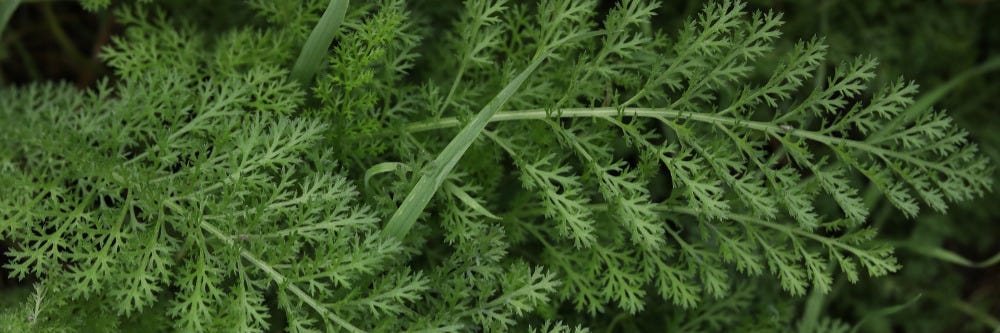
- If you crush the leaves between your fingers, you will smell a strong scent like that of chrysanthemum, except it will be more soapy or licorice-like. The leaves grow in an alternating arrangement and are feathery, with many lobes and tiny white hairs.
- From late April to mid-September, it will develop several flower stalks that looks like it grows as an umbel, but it actually grows as a corymb. The composite flowers resemble small daisies and are white, pink, yellow, gold, or red. Each individual flower is 1/4 inch across and has 4-6 ray petals.
- Yarrow fruits, often called cypsela, are oval or lance-shaped seeds about 1-2 millimeters long. They will appear ribbed along the length of the seed. More mature seeds are light tan to brown.
Use the description and image above to help you identify the yarrow on your property. If you are unsure whether the plant is yarrow, then contact us with a photo of the weed, and we will properly identify the foliage and suggest the appropriate herbicide recommendations.
Inspection
After you have confirmed that the infestation on your property is yarrow, you can proceed with inspection. During this phase, you will locate areas where yarrow is thriving and observe the conditions helping that are allowing it to survive. This information will help you in knowing where to focus your herbicide applications.
Where to Inspect
Yarrow prefers to grow in areas with full sun or partial shade, and well-drained soil. Soil types such as clay and other low-quality soil are especially susceptible to this weed.
Yarrow is a perennial weed that spreads with underground rhizomes.
Common areas where yarrow can grow are grasslands, valleys, woodlands, sand dunes, pastures, pathway edges, fallow fields, and lawns.
What to Look For
Until it develops flowers, younger yarrow plants will exist as rosettes. More mature plants will grow low to the ground in clumps.
Treatment
Before you can begin treatment, you will need to wear the proper personal protective equipment (PPE).
Using post-emergent herbicides containing 2,4-D, clopyralid, dicamba, glyphosate, triclopyr, mecoprop, chlorsulfuron, or mcpa will be most effective against yarrow.
Step 1: Mix and Apply Herbicide
Determine how much herbicide to use by measuring the square footage of the treatment area. Find the square footage by measuring the treatment area's length and width in feet, then multiply them together (length X width = square footage). For acreage, take the square footage and divide it by one acre (square footage / 43,560 sq. ft. = acres).
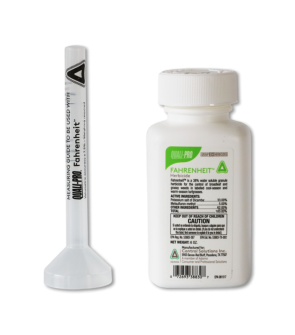
To get rid of yarrow in warm-seasoned turf, we suggest Fahrenheit Herbicide. Fahrenheit Herbicide is an effective water-dispersable granule herbicide designed to eliminate a broad-spectrum of broadleaf and grassy weeds without harming warm-seasoned turf.
Apply Fahrenheit Herbicide as a spot treatment against yarrow at the rate of 0.2 oz. of product per 1 gallon of water per 1,000 sq. ft.
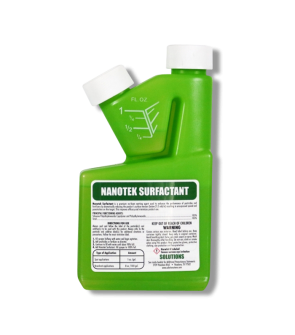
We recommend using a non-ionic surfactant to enhance the performance of this herbicide. Nanotek Surfactant is a non-ionic surfactant that greatly enhances the penetration and coverage of herbicide and insecticide material.
Just mix 1 oz. of Nanotek Surfactant per 1 gallon of spray solution.
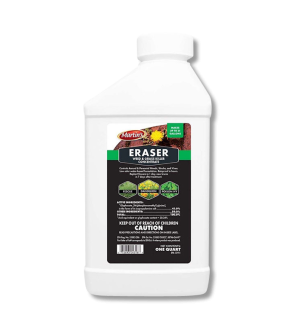
To get rid of yarrow in cool-seasoned turf and other listed sites where it shouldn't be growing we recommend Eraser 41% Glyphosate.
Keep in ming that Eraser 41% Glyphosate is a non-selective herbicide that will kill any plant it comes into contact with.
Spray Eraser 41% Glyphosate only as a spot treatment. Use 2 1/2 oz. (5 tbs.) of Eraser 41% Glyphosate per 1 gallon of water to cover 300 sq. ft.
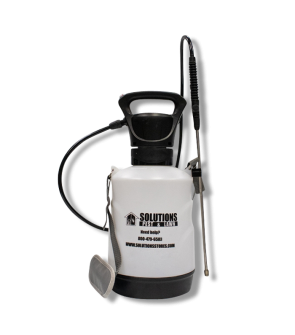
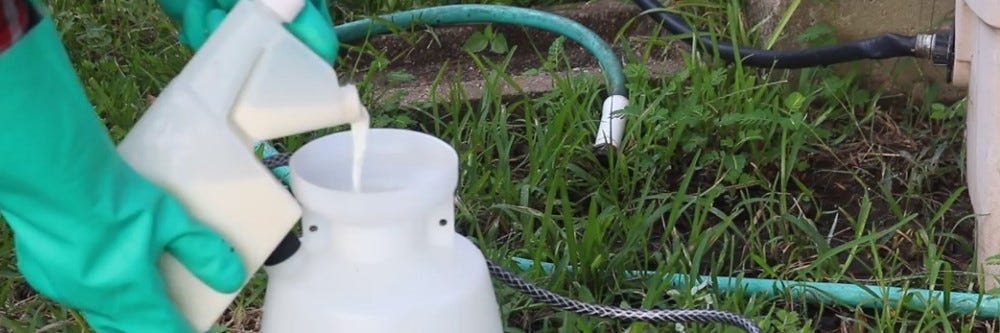
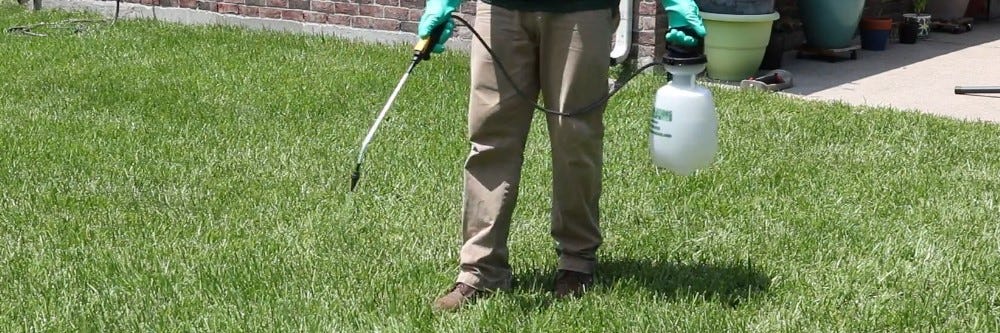
We recommend mixing and applying either herbicide in a handheld pump sprayer.
Be sure to mark the sprayer used for Eraser 41% Glyphosate for non-selective herbicide use. Only to prevent cross-contamination in the future.
To mix, fill the spray tank with half the amount of water, add the proper amount of products, then pour in the remaining half of the water. Close the tank lid and shake until the solution is well-mixed.
Spot-treat any weed you find during your inspection. Use a fan or cone spray pattern to ensure the leaves are fully coated, and spray the weed to the point of wetting but not runoff.
When using Eraser 41% Glyphosate, we suggest placing a cardboard box between the weed and desired foliage to prevent spray drift.
Step 2: Reapply Herbicide
 When applied properly, affected weeds will turn yellow and begin to die.
You may reapply Fahrenheit Herbicide when 4-6 weeks have passed after the first treatment.
Eraser 41% Glyphosate can be reapplied after 4 weeks have passed from the first application. However, you should notice results within 2 to 4 days.
Applications are most effective when the weed is young and actively growing, before flower or seed production.
Prevention
Once the yarrow has been removed, you will want to make sure it does not return. Take on the following preventative measures to prevent yarrow.
- To prevent yarrow, simply pull up new sprouts as they appear, and the attached stem will be underground. Any leftover plant part will support new growth. It is best to do this in the early spring and throughout the growing season. If you decide to use a garden hoe or dig with some other type of tool, be mindful that you will need to dig at least 12 inches deep to remove underground stems.
- Mow your yard regularly to prevent yarrow from spreading and help existing turf to fight this weed better off. Avoid mowing over existing yarrow weeds, as this can cause them to spread and become hardier. As a general rule of thumb, mow no more than 1/3 of the grass blades' height.
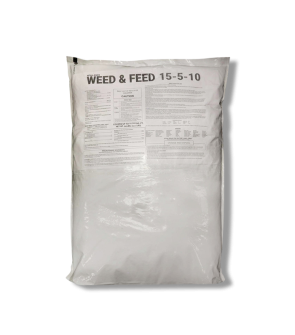
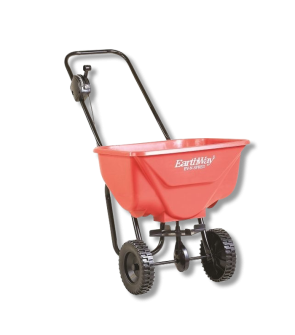
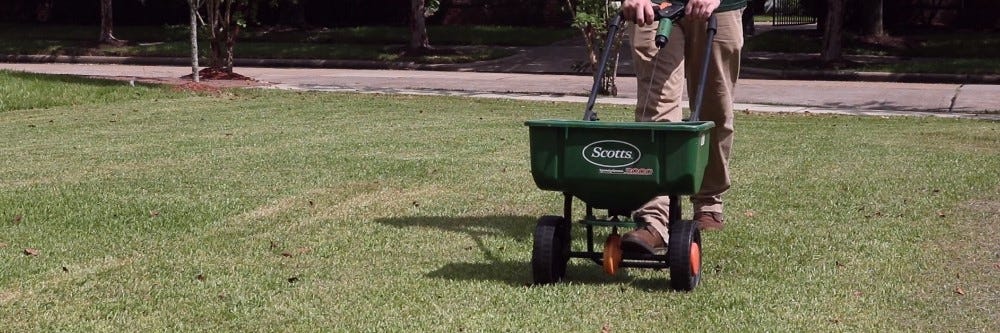
- Help your lawn to become more thick and healthy with seasonal fertilization. We suggest using a slow-release granule to give your turf the right amount of nutrients to defend against weed activity. Our recommendation is to use Solutions 15-5-10 Weed & Feed Fertilizer with Trimec, which promotes healthy turf growth while fighting against existing weeds. Mow your lawn to its normal height 1 to 2 days before application. Water the lawn thoroughly at least 1 day before application. If the grass is not moist at the time of application, sprinkle lightly with water. For most applications, you will use 3.2 to 4.0 pounds of Solutions 15-5-10 Weed & Feed Fertilizer with Trimec per 1,000 sq. ft. With a push or broadcast spreader, the granules are evenly distributed across the treated area. Water the treated area again when 1 to 2 days have passed after application.
Key Takeaways
What is Yarrow?
- Yarrow is a flowering plant that can be considered a weed due to its ability to smother other plants with its foliage and roots.
How to Get Rid of Yarrow
- To get rid of yarrow, we recommend using Fahrenheit Herbicide or Eraser 41% Glyphosate.
Preventing Yarrow Reinfestation
- To prevent yarrow from reappearing in your yard, you will need to take on some cultural practices such as mowing, hand-pulling weeds as they appear, and regular fertilizer applications such as Solutions 15-5-10 Weed & Feed Fertilizer with Trimec.