

Gain access to personalized product screening, the best pricing, rewards, and more!
Create An Account, Or Sign In.
Most Effective Products
Florida Pusley Control: How to Get Rid of Florida Pusley
This page is a general DIY guide for controlling Florida pusley. Using the suggested products and methods, you can control Florida pusley. Follow this DIY article and use the recommended products, and we guarantee 100% control of Florida pusley.
Florida pusley, also known as rough Mexican clover, Florida snow weed, or by its scientific name Richardia scabra has become one of the most frustrating weeds plaguing warm-seasoned lawns across the southeastern half of the United States. Homeowners often mistake it's small white flowers for something harmless, but Florida pusley spreads aggressively and dominates a yard quickly.
Beyond its rapid growth, Florida pusley poses a significant threat to the overall health and appearance of yards and desired plants. It's deep taproots compete directly with grass for essential nutrients, sunlight, and moisture. Once established, Florida pusley spreads outward with surprising speed, forming thick clusters that choke out desirable foliage.
Over time, these unsightly patches created by Florida pusley become more noticeable, diminishing the lawn's appearance and overall aesthetic. As this broadleaf weed becomes more established, it also sets the stage for additional weed and pest infestations. If you are prepared, our DIY guide highlights the essential products and tips you will need to control and prevent Florida pusley.
Identification
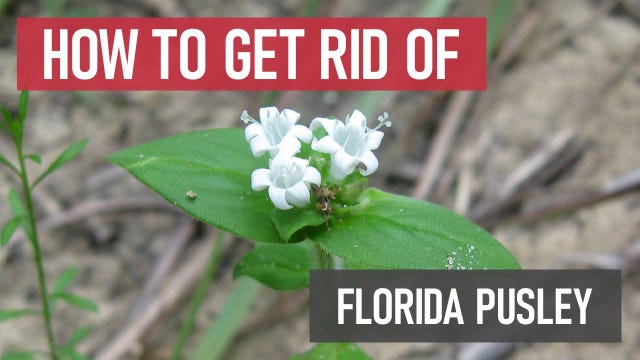
Before proceeding with a treatment plan, you must be aware the weed you are seeing is Florida pusley and not some other weed. Misidentification can lead to using the wrong treatment methods, which can waste your time and money. To know what Florida pusley looks like, take a look at the following characteristics.
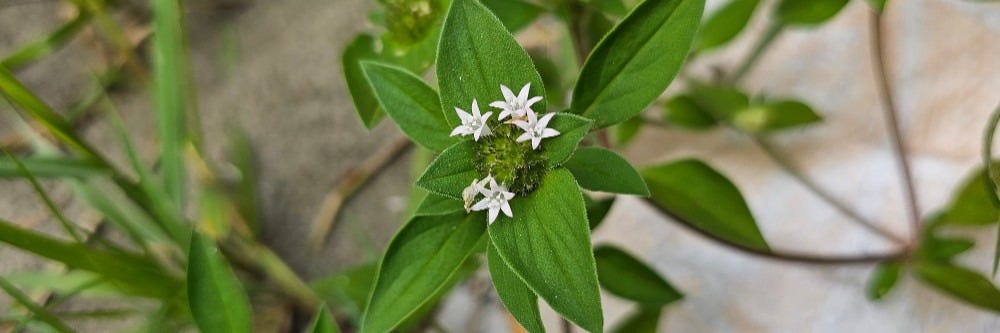
- Florida pusley is a low-branching summer annual weed that has hairy stems (often tinged red) growing along the ground, reaching up to 30 inches in length. If left unchecked, the growth can become erect with stems growing 2.5 feet in height.
- The entire plant is loosely branched and covered with soft hairs, including its opposite, lanceolate to oval-shaped bright green leaves, which measure 1 to 3 inches long and up to 1 inch wide and taper to a point. At each node, the leaves are connected by a small sheath bearing several upright, hair-like appendages 2 to 5 mm long.
- Florida pusley produces terminal, head-like flower clusters containing 20 or more small, white, six-lobed, tubular flowers that create a star-shaped appearance near the tips of branches.
Use our description and image above to help you to identify Florida pusley. If you are having trouble identifying Florida pusley, contact us, and we will help you correctly identify the weed and offer herbicide recommendations for control.
Inspection
Once you confirm that you are dealing with Florida pusley, you can proceed to inspection. During this phase, you will locate areas where Florida pusley thrives and observe the conditions that allow it to thrive. This information will help you know where to focus your herbicide application.
Where to Inspect
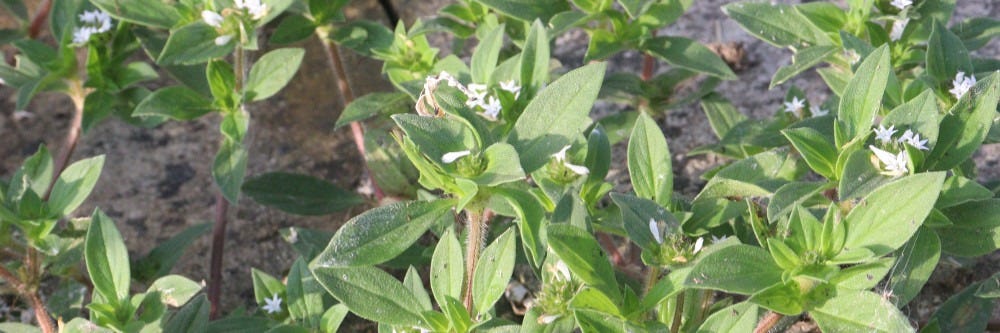
Florida pusley grows anywhere there is heat, sun, sandy or dry soil, and weakened vegetation.
It is frequently found in warm-seasoned lawns, grasslands, along roadsides, open fields, pastures, parks, abandoned lots, construction sites, golf courses, landscapes, and particularly in areas with sandy or disturbed soil.
What to Look For
Florida pusley germinates in warm soil, typically when temperatures reach 65 to 95 degrees Fahrenheit, making late spring through summer the primary period for new growth.
The weed grows low to the ground with hairy, opposite leaves and loosely branches stems that spread outward, forming dense mats.
From September through January, Florida pusley produces small, white, star-shaped, six-lobed flowers.
By observing thin or stressed turf, bare patches, and the presence of tiny white flowers, property owners can identify Florida pusley early in its growth cycle and manage it before it fully spreads.
Treatment
When treating Florida pusley, ensure you are ready for mixing and application with herbicides by wearing the proper personal protective equipment (PPE).
Because Florida pusley grows as dense, low-lying mats, mechanical control like hand-pulling is often labor-intensive. Instead, we suggest using selective post-emergent herbicides for faster and easier control.
Herbicides containing active ingredients such as 2,4-D, dicamba, mecoprop, or triclopyr are commonly recommended as they show the best results with Florida pusley. Applications are most successful when the plants are young and actively growing.
Step 1: Mix and Apply Herbicide
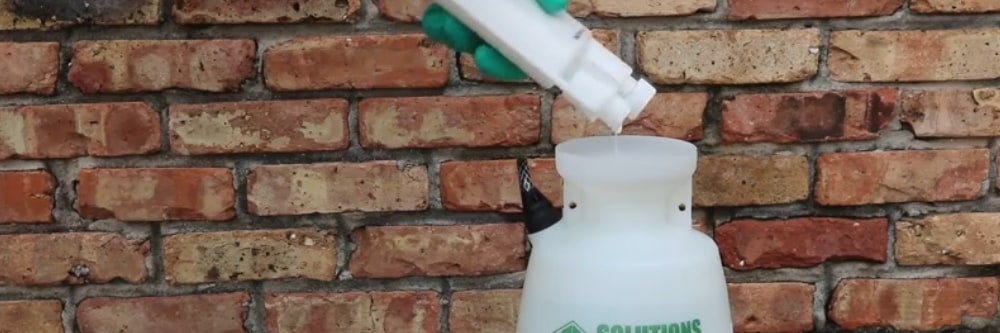
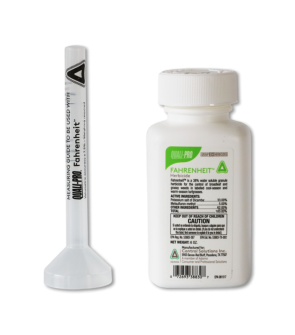
Since Florida pusley grows in warm-seasoned turf, we suggest using Fahrenheit Herbicide.
Fahrenheit Herbicide is an effective, water-dispersable, post-emergent herbicide that controls a broad-spectrum of broadleaf and grassy weeds in warm-seasoned turf.
Determine how much herbicide to use by measuring the square footage of the treatment area. Find the square footage by measuring the treatment area's length and width in feet, then multiplying them together (length X width = square footage).
For spot treatments, mix 0.2 oz. of Fahrenheit Herbicide per 1 gallon of water per 1,000 sq. ft.
To treat broader areas such as pastures and non-crop areas, 2,4-D Amine Selective Post-Emergent Herbicide would be a good choice.
Spot treatments with 2,4-D Amine Selective Post-Emergent Herbicide will use 1/4 pint of this product in 3 gallons of water.
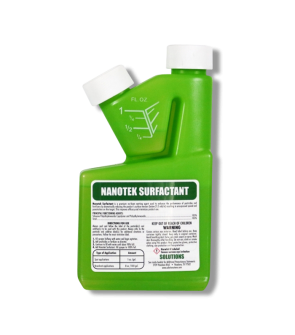
To increase the control over weeds, you can use a nonionic surfactant like Nanotek with these products. Nanotek Surfactant is a non-ionic surfactant that helps increase the spread and penetration of herbicides, insecticides, and other pesticides.
Just add 1 fluid ounce of Nanotek Surfactant per 1 gallon of solution.
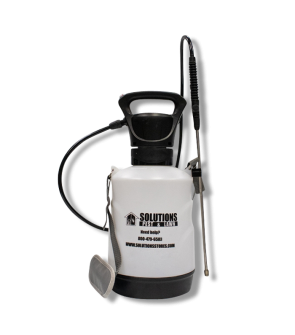
These products will need to be mixed with water in a handheld pump sprayer or backpack sprayer.
With your solution, spot-treat any weed you’ve found during your inspection. Use a fan or cone spray pattern to ensure the leaves are fully coated, and spray the weed to the point of wet but not runoff.
Be sure to spray on calm days when temperatures are not too hot and when wind speeds are low to minimize drift.
Keep people and pets away from treated areas for 24 hours after applying Fahrenheit Herbicide.
After 2,4-D Amine Selective Post-Emergent Herbicide application, you will need to keep people and pets away from treated areas until 48 hours have passed after application.
Step 2: Retreat
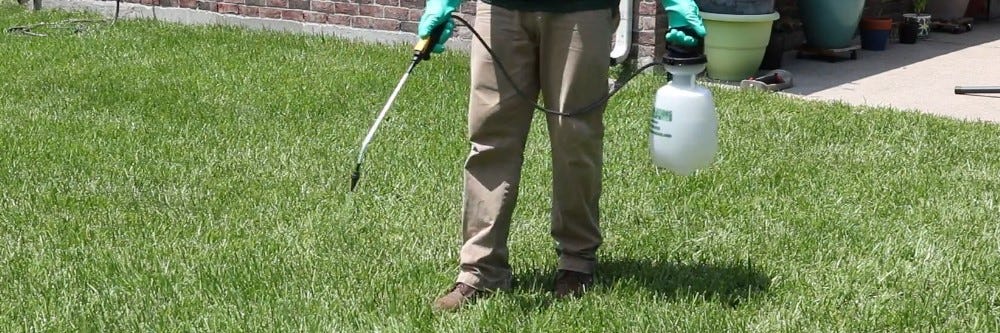 When applied properly, affected weeds will yellow and begin to die. Conduct follow-up applications as necessary.
Reapplication intervals with Fahrenheit Herbicide range from 4 to 6 weeks. Reapplication intervals with 2, 4-D Amine Selective Post-Emergent Herbicide range from 21 to 30 days.
Prevention
When Florida pusley has successfully been eliminated, you do not want it to return. Use the following preventative measures to ensure Florida pusley does not come back.
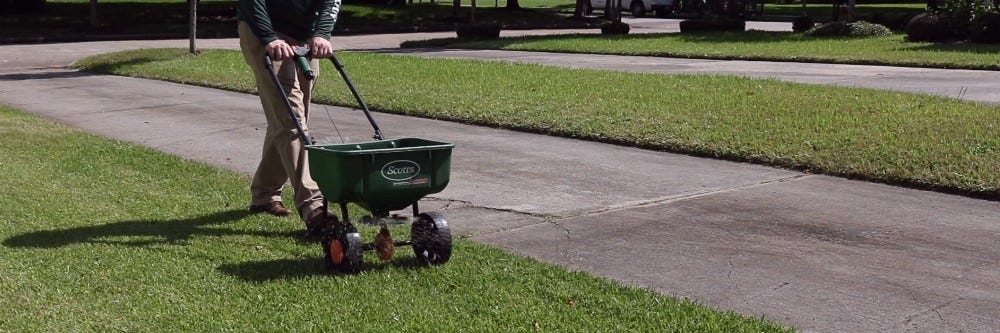
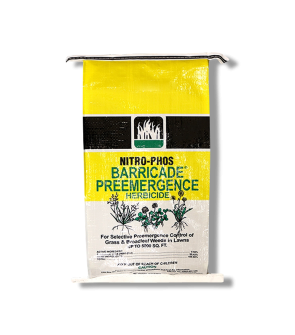
- To prevent Florida pusley from germinating, apply a pre-emergent herbicide like Barricade. Barricade Pre-Emergent Herbicide is a pre-emergent granular herbicide that creates a chemical barrier in turf and landscape ornamentals that will prevent broadleaf and grassy seeds from sprouting and emerging. Depending on your turf grass species, you will apply 1.5 to 4 pounds of product per 1,000 square feet. Spread the granules evenly across the soil surface with a push or broadcast spreader. After application, water in the product with at least half an inch of water.
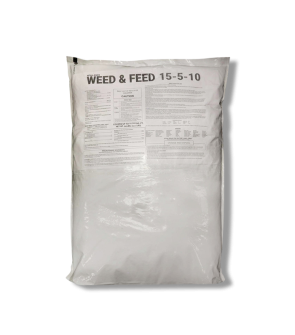
- To help prevent weeds and disease, it’s important to maintain a healthy lawn. One option is to use a fertilizer such as Solutions 15-5-10 Weed & Feed with Trimec. This slow-release formula supplies essential nutrients to your grass while also targeting existing weeds like Florida pusley. With a push spreader, apply 3.2 to 4 pounds of product per 1,000 square feet. When applied properly, your grass will receive a boost in health while the built-in herbicide will control established weeds.
- Mowing regularly at the recommended height for your grass type helps it grow thick and strong, which crowds out weeds. Watering deeply but infrequently encourages deep root growth, making your turf more resilient and less inviting to pusley. We recommend watering with no more than 1 inch of irrigation once per week, preferably in the early morning. Overseeding bare or thin areas fills in gaps where weeds could take hold, creating a dense lawn that naturally resists invasion.
Key Takeaways
What is Florida Pusley?
- Florida pusley is a low-growing, fast-spreading summer annual weed known for creating dense patches in warm-seasoned turf and more.
How to Get Rid of Florida Pusley
- To get rid of Florida pusley, you will need to use Fahrenheit Herbicide or 2,4-D Amine Selective Post-Emergent Herbicide. To aid these herbicides control, mix in Nanotek Surfactant.
Preventing Florida Pusley Reinfestation
- To prevent Florida pusley, maintain a healthy lawn through proper mowing, deep but infrequent watering, overseeding bare spots, and using pre-emergent herbicides like Barricade Pre-Emergent Herbicide to stop seeds from germinating. Additionally, applying a slow-release fertilizer like Solutions 15-5-10 Weed & Feed with Trimec, nourishes the grass while controlling existing weeds.