


Gain access to personalized product screening, the best pricing, rewards, and more!
Create An Account, Or Sign In.

SEPRO TECHNOLOGIES
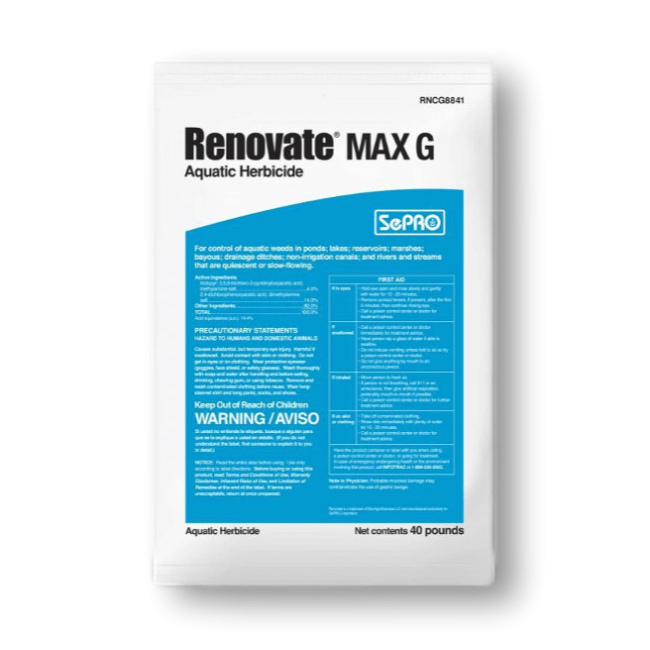
Renovate Max G Aquatic Herbicide
Renovate Max G Aquatic Herbicide is a fast-acting, granular aquatic herbicide that controls tough submerged and floating weeds, providing long-lasting, systemic weed control for ponds, lakes, drainage ditches, and more.
As low as
$197.95
Only %1 left
SKU
Renovate Max G Aquatic Herbicide Product Page
Min : 197.95 - Max : 197.95
+
Price as of
10/10/26
10/10/26
Price Transparency
See how our pricing compares to other online retailers for this item.
Renovate Max G Aquatic Herbicide, manufactured by Sepro, is a systemic, deep-acting aquatic granular herbicide designed to provide reliable control of invasive and nuisance aquatic plants in non-irrigation canals, ponds, lakes, and other water sites.
Its active ingredient, triclopyr, moves throughout aquatic plants to control deep-rooted invasive species and filamentous weeds at the source. This results in longer-lasting control of tough species that come back repeatedly with shallow contact sprays. Because Renovate Max G Aquatic Herbicide is a granular formulation, it’s easier to distribute evenly, especially in deeper water and it stays active longer in the water column and sediment compared to some liquid products.
Renovate Max G Aquatic Herbicide is a powerful, professional, and versatile solution for controlling deep-rooted submerged and emerged aquatic weeds in aquatic areas. Its granular, systemic formulation based on triclopyr allows it to reach into the plant’s root system, delivering longer-lasting control than many surface contact products. By combining systemic action, broad-use labels, and flexible application options, Renovate Max G provides real, dependable control for nutrient-rich water bodies and persistent weed species like parrotsfeather, milfoils, and water lily.
Tools Needed
A boat, helicopter, or power equipment could be used.
Use a mechanical spreader such as a fertilizer spreader, blower, mechanical seeder, an eductor system, or similar equipment for surface applications.
How to Use
- Step 1: Determine how much Renovate Max G Aquatic Herbicide to use by measuring pounds per minute, if you are performing surface applications. To find pounds per minute, you will need record the miles per hour and swath width then multiplying it by pounds per acre (miles per hour X swath width (feet) X pounds per acre = pounds per minute). Apply 4.7 to 93.7 pounds of Renovate Max G Aquatic Herbicide per 1 foot average water depth. Refer to the product label for specific application rates and restrictions.
- Step 2: Carefully pour or scoop the granules into the hopper of your mechanical spreader, blower, seeder, or eductor system, making sure the equipment is clean, dry, and stable, then secure any covers or lids before moving to the treatment area to prevent spills.
- Step 3: Begin treatment along the shore and proceed outwards in bands to allow fish to move into untreated areas. Waters having limited and less dense weed infestations may not require partial treatments.
Where to Use
For control of aquatic weeds in ponds; lakes; reservoirs; marshes; bayous; drainage ditches; non-irrigation canals; and rivers and streams that are quiescent or slow-flowing.
Do not apply directly to, or otherwise permit it to come into direct contact with grapes, tobacco, vegetable crops, flowers, or other desirable susceptible broadleaf plants, and do not permit dust to drift into these areas.
When to Use
Apply Renovate Max G Aquatic Herbicide when weeds are present.
Safety Information
Renovate Max G Aquatic Herbicide is safe for people and pets when applied according to the product label instructions. Always wear the proper personal protective equipment (PPE) when handling and applying this product.
There are no restrictions on the use of treated water for recreational purposes, including swimming, fishing and domestic purposes.
There are no restrictions on consumption of treated water for potable use by livestock, pets, or other animals.
Special Considerations
Consult with appropriate state or local pesticide and/or water authorities before applying this product in or around pubic waters. Permits and posting or treatment notification may be required by state or local public agencies.
| Restricted Use | No |
|---|---|
| Shipping Restrictions | AK, CT, HI, NY |
| Availability | Online |
| Signal Word | WARNING |
| Keith's Pro Tip | "Encourage water circulation and aeration to reduce stagnant areas where weeds thrive. Installing beneficial aquatic plants can outcompete invasive species, while shading methods such as aquatic dyes limit sunlight and slow weed growth naturally." |
| Time to Kill | Herbicidal symptoms are initially expressed 2 to 14 days following application and usually involve bending and twisting of apical sections and shoots of susceptible plants. Initial symptoms are followed by necrosis of terminal buds and above ground tissue. Generally, target plants are controlled within 2 to 4 weeks after treatment, but depending on conditions and plant species can take up to 8 weeks for complete control. |
| Chemical Type | Herbicide |
| Formulation | Granular |
| Application Methods | Granular Spreading |
| Product Drawbacks | If treated water is intended to be used to irrigate non-crop areas not labeled for direct treatment with triclopyr and 2,4-D (e.g., landscape ornamentals) or for other irrigation uses not described, consult with SePRO Corporation prior to irrigation. |
| Active Ingredient | Triclopyr 4.0% |
| Application Equipment | Aerial Application Equipment, Hand Spreader |
| Mix Rate | Apply 4.7 to 93.7 pounds of Renovate Max G Aquatic Herbicide per 1 foot average water depth. |
| Use Sites | Outdoors |
| Yield | Coverage will vary. |
| EPA Registration No. | 67690-50 |
| Shelf Life | Renovate Max G Aquatic Herbicide will last for 3 years when stored in a dry, clean area. |
| Comparable Products | Triclopyr 3 Herbicide |
| Children or pets? | No |
| Property Characteristics | None |
| Availability | Online |
| Restricted Use | No |
| Brand | SEPRO TECHNOLOGIES |
| Keith's Pro Tips | "Encourage water circulation and aeration to reduce stagnant areas where weeds thrive. Installing beneficial aquatic plants can outcompete invasive species, while shading methods such as aquatic dyes limit sunlight and slow weed growth naturally." |
| Product Drawbacks | If treated water is intended to be used to irrigate non-crop areas not labeled for direct treatment with triclopyr and 2,4-D (e.g., landscape ornamentals) or for other irrigation uses not described, consult with SePRO Corporation prior to irrigation. |
| Target Pests | Bladderwort, Coontail, Eurasian Watermilfoil, Flowering Rush, Hybrid Watermilfoil, Northern Watermilfoil, Parrotsfeather, Variable-leaf Milfoil, Water Chesnut, Water Stargrass, Watershield, White Water Lily, and Yellow Water Lily. |
| Application Equipment | Aerial Application Equipment, Hand Spreader |
| Application Methods | Granular Spreading |
| Active Ingredient | Triclopyr 4.0% |
| Product Type | Herbicide |
| Formulation | Granular |
| Application Rate | Apply 4.7 to 93.7 pounds of Renovate Max G Aquatic Herbicide per 1 foot average water depth. |
| Shelf Life | Renovate Max G Aquatic Herbicide will last for 3 years when stored in a dry, clean area. |
| Yield | Coverage will vary. |
| Use Sites | Outdoors |
| Time to Kill | Herbicidal symptoms are initially expressed 2 to 14 days following application and usually involve bending and twisting of apical sections and shoots of susceptible plants. Initial symptoms are followed by necrosis of terminal buds and above ground tissue. Generally, target plants are controlled within 2 to 4 weeks after treatment, but depending on conditions and plant species can take up to 8 weeks for complete control. |
| Comparable Products | Triclopyr 3 Herbicide |
| Use Caution With | Bentgrass, Kikuyugrass, St Augustine, Zoysiagrass |
| EPA Registration # | 67690-50 |

*Price does not include freight. We guarantee our rate plus shipping will be less than anyone else's price.