


Gain access to personalized product screening, the best pricing, rewards, and more!
Create An Account, Or Sign In.


GOWAN
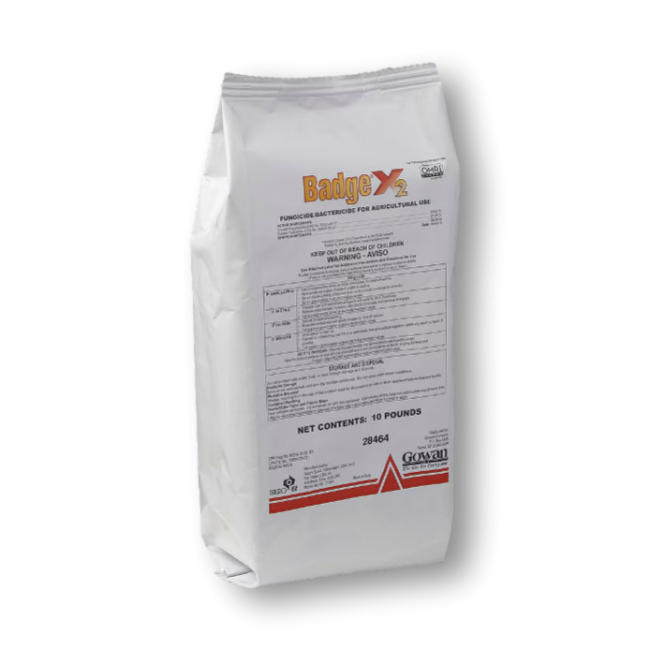
Badge X2 Bactericide/Fungicide
Badge X2 Bactericide/Fungicide is a patented, OMRI-listed plant protection solution that delivers fast, long-lasting disease control with superior rain resistance, easy mixing, and no visible residue, helping growers maximize crop and ornamental health and quality under any conditions.
Only %1 left
SKU
Badge X2 Bactericide/Fungicide Product Page
Min : 104.21 - Max : 104.21

+
+
Price as of
10/10/26
10/10/26
Price Transparency
See how our pricing compares to other online retailers for this item.
Badge X2 Bactericide/Fungicide, manufactured by Gowan, is a trusted copper-based fungicide/bactericide that provides immediate disease protection plus long-lasting residual control, even through rain on agricultural crops and ornamentals.
It is formulated using a patented dual-copper system that combines copper oxychloride and copper hydroxide. This dual-copper approach delivers fast knockdown for immediate protection along with extended residual control and excellent wash-off resistance, all without leaving behind the blue residue commonly associated with older copper products.
Badge X2 Bactericide/Fungicide sets the standard for modern copper disease control by combining fast-acting copper hydroxide with long-lasting copper oxychloride in one OMRI-listed, easy-to-use formulation. Whether you farm organically or conventionally, this OMRI product provides dependable, broad-spectrum protection on crops that holds up under real-world conditions.
Tools Needed
A backpack sprayer, spray rig or aircraft equipment will be needed.
How to Use
- Step 1: Determine how much Badge X2 Bactericide/Fungicide to use by measuring the square footage of the treatment area. Find the square footage by measuring the treatment area's length and width in feet, then multiplying them together (length X width = square footage). For acreage, take the square footage and divide it by one acre (square footage / 43,560 sq. ft. = acres). For ornamentals, Badge X2 should be applied at rate of 1.5 to 5 pounds per 100 gallons of water per acre. When new growth is present on ornamentals, apply at 1.5 to 2 pounds of product per 1 gallon of water per 1,000 square feet. For fresh market tomatoes, use 0.75 to 1.8 pounds of product per 100 gallons of water per acre. For processing tomatoes, apply 0.47 to 1.125 tbsp. of product in sufficient water volume per 100 sq. ft. Refer to the product label for specific application rates and restrictions.
- Step 2: Fill the sprayer with half the amount of water, add the proper amount of product, and pour in the remaining half the water. Close the tank lid and shake well until mixed.
- Step 3: Spray thoroughly over the crop canopy to the point of wet, but not runoff. Do not apply with a nozzle height greater than 4 feet above the crop canopy.
Where to Use
Badge X2 Bactericide/Fungicide s labeled for use on a wide variety of crops, including citrus fruits like grapefruit, kumquat, lemon, lime, orange, pummelo, tangelo, and tangerine. It is also suitable for many field crops such as alfalfa, cereal grains (including barley, millet, oat, rye, sorghum, triticale, and wheat), clover, corn, peanut, potato, soybean, sugar beet, sugarcane, and timothy grass. For small fruits, it can be applied to brambles like blackberry and raspberry, blueberry, cranberry, currant, gooseberry, and strawberry. Tree crops and fruits covered include apple, apricot, atemoya, avocado, banana, carambola, cherimoya, cherry, guava, litchi, mamey sapote, mango, nectarine, olive, papaya, peach, pear, persimmon, plantain, plum, prune, and quince. Tree nuts such as almond, cacao, chestnut, coffee, filbert, macadamia, nutmeg, pecan, pistachio, and walnut are also included. Vegetables listed range from arugula, artichoke, asparagus, beans (dry and green), beet, beet greens, carrot, celery, celeriac, chard, various brassicas, cucurbits like cantaloupe and cucumber, eggplant, endive, escarole, garlic, leek, lettuce, okra, onion, pea, pepper, radish, rhubarb, rutabaga, shallot, spinach, tomato, to watercress. Vines such as grape, hops, kiwi, and passion fruit are covered, along with herbs including basil, chives, cilantro, coriander, dill, lavender, mint, oregano, parsley, rosemary, and thyme. Miscellaneous plants like ginseng, live oak, sycamore, and turfgrass are also listed. Additionally, Badge X2 may be used in greenhouses and shadehouses to control diseases on any labeled crop suited to greenhouse or shadehouse culture, with specific directions provided for citrus, cucumber, eggplant, pepper, and tomato.
When to Use
Use as pre-bloom and post-bloom sprays, applying during spring flush, summer new growth, and repeating on subsequent flushes when disease pressure is high. Begin fall applications before or just after the first rain and continue as needed, following specific timing depending on the crop. For trunk protection, it can also be applied as a coating prior to heavy rains or freeze conditions.
Safety Information
Badge X2 Bactericide/Fungicide is safe for people and pets when applied according to the product label instructions. Always wear the proper personal protective equipment (PPE) when mixing and applying this product.
The pre harvest interval (PHI) is 0 days for all crops. Reentry into treated areas and harvest of treated crops can be performed when wearing required personal protective equipment when 24 hours have passed for greenhouse and 48 hours for field applications.
Special Considerations
It must not be applied in a spray solution having a pH of less than 6.5 as phytotoxicity may occur.
This product may be reactive on masonry and metal surfaces such as galvanized roofing. Avoid contact with metal surfaces. Do not spray on cars, houses, lawn furniture, or other metallic surfaces.
| Restricted Use | No |
|---|---|
| Shipping Restrictions | AK, DC, IL |
| Availability | Online |
| Signal Word | WARNING |
| Keith's Pro Tip | "Remove plant debris promptly, disinfect tools and surfaces regularly, and provide proper spacing to improve air circulation and reduce humidity to better prevent diseases in greenhouses." |
| Time to Kill | Badge X2 Bactericide/Fungicide will control diseases within weeks. |
| Chemical Type | Herbicide |
| Formulation | Water Dispersible Granule (WDG) |
| Application Methods | Broadcast Spray |
| Product Drawbacks | Spray injury may occur with sensitive varieties such as Lahontan. |
| Active Ingredient | Copper Oxychloride 23.82% Copper Hydroxide 21.49% |
| Application Equipment | Aerial Application Equipment, Backpack Sprayer, Spray Rig |
| Mix Rate | For ornamentals, Badge X2 should be applied at rate of 1.5 to 5 pounds per 100 gallons of water per acre. When new growth is present on ornamentals, apply at 1.5 to 2 pounds of product per 1 gallon of water per 1,000 square feet. For fresh market tomatoes, use 0.75 to 1.8 pounds of product per 100 gallons of water per acre. For processing tomatoes, apply 0.47 to 1.125 tbsp. of product in sufficient water volume per 100 sq. ft. |
| Use Sites | Outdoors |
| Yield | Coverage will vary depending on the crop. |
| EPA Registration No. | 10163-402 |
| Shelf Life | Badge X2 Bactericide/Fungicide will last for 3 years when stored in a dry, clean area. |
| Comparable Products | Liqui Cop Copper Fungicide |
| Children or pets? | No |
| Property Characteristics | None |
| Availability | Online |
| Restricted Use | No |
| Brand | GOWAN |
| Keith's Pro Tips | "Remove plant debris promptly, disinfect tools and surfaces regularly, and provide proper spacing to improve air circulation and reduce humidity to better prevent diseases in greenhouses." |
| Product Drawbacks | Spray injury may occur with sensitive varieties such as Lahontan. |
| Target Pests | Algal Leaf Spot And Twig Infection, Alternaria Leaf And Fruit Spot, Angular Leaf Spot, Anthracnose, Apple Scab (Venturia Inaequailis), Bacterial Blight (Pseudomonas), Bacterial Canker, Bacterial Leaf Blight (Pseudomonas Syringae), Bacterial Leaf Spot, Bacterial Soft Rot (Erwinia), Bacterial Speck Of Tomato (Pseudomonas), Bacterial Spot, Bacterial Spot (Xanthomonas), Bacterial Spot Of Tomatoes, Ball Moss, Black Leaf Spot (Alternaria), Black Pitting, Black Pod Of Cacao (Phytophthora), Black Rot, Black Rot (Xanthomonas), Black Sigatoka (Cercospora), Black Spot, Blossom And Shoot Blasts, Blossom Blast (Pseudomonas), Blotch, Blue Mold, Botrytis Blight, Botrytis Gray Mold (B. Cinerea), Brown Rot Blossom Blt. (Monilinia), Brown Spot, Brown Spot (Alternaria), Bud Rot (Phytophthora), Cane Spot (Ascospora), Cercospora Leaf & Fruit Spot, Cherry Leaf Spot (Coccomyces), Citrus Canker, Cladosporium Leaf Mold/Gray Leaf Mold, Coffee Disease, Collar Rot (Phytophthora), Colletotrichum, Common Blight (Xanthomonas), Dieback, Dieback (Phytophthora), Downy Mildew, Early Blight, Early Blight (Cercospora), Eastern Filbert Blight, Entomosporium Maculata, Erwinia, European Canker (Nectria), Fire Blight (Erwinia), Flower Spot (Alternaria), Foot Rot (Phytophthora), Fruit Blotch (Phyllosticta Solitaria), Fruit Rot (Alternaria), Greasy Spot (Cercospora), Gummy Stem Blight (Mycosphaerella Citrullina/Melonis), Halo Blight (Pseudomonas), Helminthosporium Spot Blotch, Ice Nucleating Bacteria (Erwinia), Ice Nucleating Bacteria (Pseudomonas), Iron Spot (Cercospora), Kernel Rot (Phytophthora Cactorum), Late Blight, Late Blight (Septoria), Leaf Blight, Leaf Curl, Leaf Rust, Leaf Scorch, Leaf Spot, Leaf Spot (Entomosporium), Leaf Spot (Exosporium), Leaf Spot (Pestalotia), Leaf Spot (Phoma), Leptosphaerulina Leaf Spot, Melanose (Diaporthe), Needle Cast (Rhabdocline), Olive Knot (Pseudomonas Savastanoi), Panicle Blight (Cercospora), Peacock Spot (Cycloclonium), Pecan Shuck Disease, Phomopsis, Pink Disease Of Coffee (Corticium Salmonicolor), Pink Pitting (Mycosphaerella), Powdery Mildew, Pseudomonas Spp., Purple Blotch (Alternaria), Red Algae, Red Leaf Spot (Helminthosporium), Rhizoctonia Foliage Blight, Rose Bloom (Exobasidium), Scab, Septoria Leaf Blotch, Septoria Spot, Shoot Blight (Botryosphaeria), Stem Blight, Stem Canker, Tip Blight (Botrytis), Twig Blight, Volutella Leaf & Branch Blight, Walnut Blight (Cylindrocladium), White Rust (Albugo), Xanthomonas Leaf Spot, Yellow Rust (Kuehneola), Yellow Sigatoka (Cercospora), and Zonate Leaf Spot Of Pecan (Cristulariella Pyramidalis). |
| Application Equipment | Aerial Application Equipment, Backpack Sprayer, Spray Rig |
| Application Methods | Broadcast Spray |
| Active Ingredient | Copper Oxychloride 23.82% Copper Hydroxide 21.49% |
| Product Type | Herbicide |
| Formulation | Water Dispersible Granule (WDG) |
| Application Rate | For ornamentals, Badge X2 should be applied at rate of 1.5 to 5 pounds per 100 gallons of water per acre. When new growth is present on ornamentals, apply at 1.5 to 2 pounds of product per 1 gallon of water per 1,000 square feet. For fresh market tomatoes, use 0.75 to 1.8 pounds of product per 100 gallons of water per acre. For processing tomatoes, apply 0.47 to 1.125 tbsp. of product in sufficient water volume per 100 sq. ft. |
| Shelf Life | Badge X2 Bactericide/Fungicide will last for 3 years when stored in a dry, clean area. |
| Yield | Coverage will vary depending on the crop. |
| Use Sites | Outdoors |
| Time to Kill | Badge X2 Bactericide/Fungicide will control diseases within weeks. |
| Comparable Products | Liqui Cop Copper Fungicide |
| EPA Registration # | 10163-402 |

*Price does not include freight. We guarantee our rate plus shipping will be less than anyone else's price.