


Gain access to personalized product screening, the best pricing, rewards, and more!
Create An Account, Or Sign In.


BASF
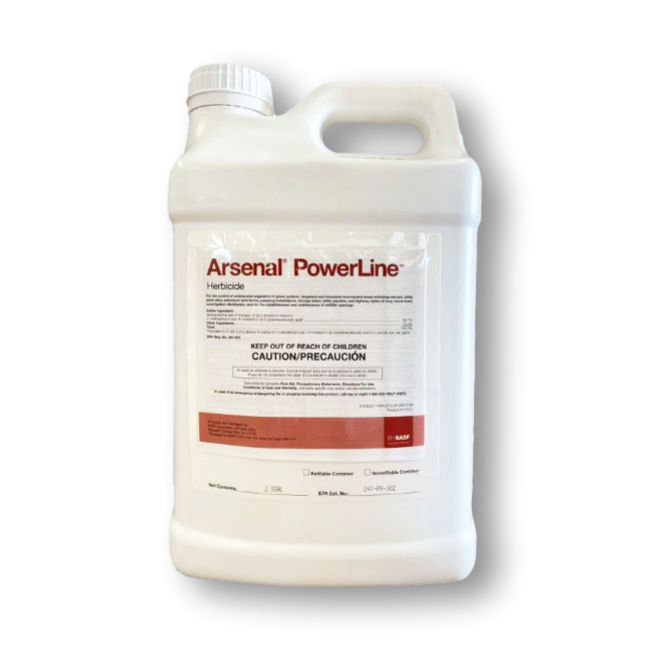
Arsenal PowerLine Herbicide
Arsenal PowerLine Herbicide is a unique systemic herbicide that delivers excellent woody plants, brush, and broadleaf weed control in grass pasture, rangeland and industrial noncropland areas.
As low as
$304.76
Only %1 left
SKU
Arsenal PowerLine Herbicide Product Page
Min : 304.76 - Max : 304.76

+
Price as of
04/11/26
04/11/26
Price Transparency
See how our pricing compares to other online retailers for this item.
Arsenal PowerLine Herbicide, manufactured by BASF, is a powerful systemic herbicide formulated for long-term vegetation control in industrial, forestry, and utility settings. It is designed to manage unwanted woody plants, brush, and broadleaf weeds, preventing regrowth and ensuring clean, manageable properties.
This pre- and post-emergent herbicide contains imazapyr, which works by inhibiting essential enzyme production in plants, leading to total control from root to leaf. Its highly effective, low-use-rate formula makes it an ideal solution for right-of-way maintenance, railroads, pipeline corridors, and non-crop areas.
Arsenal PowerLine Herbicide is an excellent non-selective, residual herbicide that provides season-long control, helping professionals manage large-scale vegetation with minimal reapplications.
Tools Needed
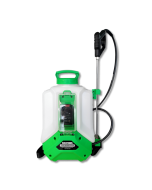
It can be applied with a backpack sprayer, hydraulic handgun, spray rig or other boom equipment.
How to Use
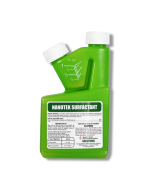
- Step 1: Determine how much Arsenal PowerLine Herbicide to use by measuring the square footage of the treatment area. Find the square footage by measuring the treatment area's length and width in feet, then multiply them together (length X width = square footage). For acreage, take the square footage and divide it by one acre (square footage / 43,560 sq. ft. = acre). For spot treatment control in grass pastures and rangelands use at the rate of 2 to 48 fl. oz. of Arsenal PowerLine Herbicide per 100 gallons of water per treated acre. Add 1 quart of surfactant with 100 gallons of spray solution. Refer to the product label for specific application rates and restrictions.
- Step 2: Fill the spray tank with half the amount of water, add the proper amount of product, then pour in the remaining half of the water. Close the tank lid and shake until the solution is well-mixed.
- Step 3: Uniformly cover the foliage of the vegetation to be controlled (including the top and bottom of leaves), but do not apply to runoff. Excessive wetting of foliage is not recommended.
Where to Use
Arsenal PowerLine Herbicide can be used in grass pasture, rangeland and industrial noncropland areas including railroad, utility plant sites, petroleum tank farms, pumping installations, storage areas; utility, pipeline, and highway rights-of-way; fence rows; nonirrigation ditchbanks; and for the establishment and maintenance of wildlife openings.
The product may not be used under pavement on residential properties such as driveways or parking lots, nor in recreational areas such as under bike or jogging paths, golf-cart paths, or tennis courts, or where landscape plantings could be anticipated.
Do not use on lawns, walks, driveways, tennis courts, or similar areas.
When to Use
Apply during active growth periods of unwanted vegetation, typically from spring through summer.
It is rainfast after 1 hour of application.
Do not apply to grass during its first growing season.
Safety Information
Arsenal PowerLine Herbicide is safe to use around children and pets when applied according to the product label instructions. Always wear the proper personal protective equipment (PPE) when mixing and applying this product.
Do not allow people or pets enter the treated area until 48 hours have passed after application.
Special Considerations
A surfactant must be used with each treatment site except when treating bermudagrass and bahiagrass.
Untreated trees can occasionally be affected by root uptake of Arsenal PowerLine through movement into the top soil. Injury or loss of desirable trees or other plants may result if Arsenal PowerLine is applied on or near desirable trees or other plants, on areas where their roots extend, or in locations where the treated soil may be washed or moved into contact with their roots.
| Restricted Use | No |
|---|---|
| Shipping Restrictions | CA |
| Availability | Online |
| Signal Word | CAUTION |
| Keith's Pro Tip | "Site with powdery, dry or light sandy soils are not recommended to be treated. However, you can treat these sites if you water them in thus helping prevent drift onto nearby sites and desired foliage." |
| Time to Kill | Chlorosis and tissue necrosis may not be apparent in some plant species until 2 weeks after application. Complete kill of plants may not occur for several weeks. |
| Chemical Type | Herbicide |
| Formulation | Emulsifiable Concentrate (EC) |
| Application Methods | Broadcast Spray, Spot Treatment |
| Product Drawbacks | Injury or death of desirable plants may result if this product is applied where roots are present or where they may extend into the treated area. |
| Active Ingredient | Imazapyr 26.7% |
| Application Equipment | Backpack Sprayer, Spray Rig |
| Mix Rate | For spot treatment control in grass pastures and rangelands use at the rate of 2 to 48 fl. oz. of Arsenal PowerLine Herbicide per 100 gallons of water per treated acre. Add 1 quart of surfactant with 100 gallons of spray solution. |
| Use Sites | Outdoors |
| Yield | 2.5 gallons of Arsenal PowerLine Herbicide will cover up to 5 acres. |
| EPA Registration No. | 241-431 |
| Shelf Life | Arsenal PowerLine Herbicide will last for 3 years when stored in a dry, clean area. |
| Comparable Products | TVC Total Vegetation Control |
| Children or pets? | No |
| Property Characteristics | Grazing Animals |
| Availability | Online |
| Restricted Use | No |
| Brand | BASF |
| Keith's Pro Tips | "Site with powdery, dry or light sandy soils are not recommended to be treated. However, you can treat these sites if you water them in thus helping prevent drift onto nearby sites and desired foliage." |
| Product Drawbacks | Injury or death of desirable plants may result if this product is applied where roots are present or where they may extend into the treated area. |
| Target Pests | Alligatorweed, Alligatorweed (Preemergence), American Beech, Annual Bluegrass, Annual Bluegrass (Preemergence), Annual Spurge, Arrowwood, Ash, Ash (Preemergence), Bahiagrass, Bahiagrass (Preemergence), Baldcypress, Barnyardgrass, Beardgrass, Beardgrass (Preemergence), Bedstraw, Bermudagrass, Bermudagrass (Preemergence), Big Bluestem (Preemergence), Big Bluestems, Bigleaf Maple, Bishops Goutweed (Bishopsweed), Blackgum, Boxelder, Boxelder (Preemergence), Brazilian Peppertree, Broadleaf Signalgrass, Broadleaf Signalgrass (Preemergence), Broom Snakeweed, Browntop Panicum, Bull Thistle, Bull Thistle (Preemergence), Burclover, Burdock, Burdock (Preemergence), Buttercup, Camelthorn, Canada Bluegrass, Canada Bluegrass (Preemergence), Canada Thistle, Canada Thistle (Preemergence), Carolina Geranium, Carolina Geranium (Preemergence), Carpetweed, Carpetweed (Preemergence), Cattail, Cattail (Preemergence), Cheat, Cheat (Preemergence), Cherry, Cherry (Preemergence), Chinaberry, Chinese Tallowtree, Chinese Tallowtree (Preemergence), Clover, Clover (Preemergence), Cocklebur, Cocklebur (Preemergence), Cogongrass, Common Chickweed, Common Chickweed (Preemergence), Common Ragweed, Common Ragweed (Preemergence), Crabgrass, Crabgrass (Preemergence), Crowfootgrass, Cudweed, Dallisgrass, Dallisgrass (Preemergence), Dandelion, Dandelion (Preemergence), Diffuse Knapweed, Dock, Dock (Preemergence), Dogfennel, Dogfennel (Preemergence), Dogwood, Dogwood (Preemergence), Downy Brome, Downy Brome (Preemergence), Fall Panicum, Fall Panicum (Preemergence), Feathertop, Feathertop (Preemergence), Fescue, Fescue (Preemergence), Fiddleneck, Field Bindweed, Field Bindweed (Preemergence), Field Sandbur, Field Sandbur (Preemergence), Filaree, Filaree (Preemergence), Fleabane, Fleabane (Preemergence), Florida Pusley, Florida Pusley (Preemergence), Foxtail, Foxtail (Preemergence), Giant Ragweed, Giant Ragweed (Preemergence), Giant Reed, Goldenrod, Goldenrod (Preemergence), Goosegrass, Goosegrass (Preemergence), Greenbrier, Greenbrier (Preemergence), Guineagrass, Guineagrass (Preemergence), Hawthorn, Hawthorn (Preemergence), Hedge Bindweed, Hedge Bindweed (Preemergence), Henbit, Hickory, Hickory (Preemergence), Hoary Vervain, Hoary Vervain (Preemergence), Honeylocust, Honeysuckle, Honeysuckle (Preemergence), Hop Clover, Indian Mustard, Indian Mustard (Preemergence), Italian Ryegrass, Italian Ryegrass (Preemergence), Itchgrass, Itchgrass (Preemergence), Japanese Bamboo, Johnsongrass, Johnsongrass (Preemergence), Johnsongrass (Seedling), Junglerice, Kentucky Bluegrass, Kentucky Bluegrass (Preemergence), Knotweed, Knotweed (Preemergence), Kochia, Kochia (Preemergence), Kudzu, Kudzu (Preemergence), Lambsquarters, Lambsquarters (Preemergence), Lespedeza, Lespedeza (Preemergence), Little Barley, Little Mallow, Little Mallow (Preemergence), London Rocket, London Rocket (Preemergence), Lovegrass, Lovegrass (Preemergence), Macartney Rose, Macartney Rose (Preemergence), Maidencane, Maidencane (Preemergence), Maple, Maple (Preemergence), Melaleuca, Milkweed, Milkweed (Preemergence), Minerslettuce, Minerslettuce (Preemergence), Morningglory, Morningglory (Preemergence), Mouseear Chickweed, Mouseear Chickweed (Preemergence), Mulberry, Mulberry (Preemergence), Mullein, Mullein (Preemergence), Multiflora Rose, Multiflora Rose (Preemergence), Nettleleaf Goosefoot, Nettleleaf Goosefoot (Preemergence), No Pest, Oak, Oak (Preemergence), Orchardgrass, Orchardgrass (Preemergence), Oxeye Daisy, Oxeye Daisy (Preemergence), Paragrass, Paragrass (Preemergence), Pepperweed, Pepperweed (Preemergence), Persimmon, Persimmon (Preemergence), Phragmites, Phragmites (Preemergence), Pigweed, Pigweed (Preemergence), Poison Ivy, Poison Ivy (Preemergence), Pokeweed, Pokeweed (Preemergence), Poplar, Poplar (Preemergence), Prairie Cordgrass, Prairie Cordgrass (Preemergence), Prairie Threeawn, Prairie Threeawn (Preemergence), Primrose, Primrose (Preemergence), Privet, Privet (Preemergence), Prostrate Knotweed, Puncturevine, Puncturevine (Preemergence), Purple Loose Strife, Purslane, Purslane (Preemergence), Quackgrass, Quackgrass (Preemergence), Rabbitbrush, Red Alder, Red Maple, Red Maple (Preemergence), Redvine, Redvine (Preemergence), Reed Canarygrass, Reed Canarygrass (Preemergence), Rush Skeletonweed, Russian Knapweed, Russian Knapweed (Preemergence), Russian Olive, Russian Thistle, Russian Thistle (Preemergence), Sago Pondweed, Saltbush, Saltcedar, Saltgrass, Saltgrass (Preemergence), Sand Dropseed, Sand Dropseed (Preemergence), Sandbur, Sandbur (Preemergence), Sassafras, Sassafras (Preemergence), Shepherdspurse, Signalgrass, Silverleaf Nightshade, Silverleaf Nightshade (Preemergence), Smartweed, Smartweed (Preemergence), Smooth Brome, Smooth Brome (Preemergence), Sorrel, Sorrel (Preemergence), Sourwood, Sowthistle, Sowthistle (Preemergence), Sprangletop, Sprangletop (Preemergence), Stinging Nettle, Stinging Nettle (Preemergence), Sumac, Sumac (Preemergence), Sunflower, Sunflower (Preemergence), Sweetclover, Sweetclover (Preemergence), Sweetgum, Sweetgum (Preemergence), Tansymustard, Tansymustard (Preemergence), Texas Panicum, Texas Thistle, Texas Thistle (Preemergence), Timothy, Timothy (Preemergence), Torpedograss, Torpedograss (Preemergence), Trumpetcreeper, Trumpetcreeper (Preemergence), Vaseygrass, Vaseygrass (Preemergence), Velvetleaf, Virginia Creeper, Virginia Creeper (Preemergence), White Clover, Wild Barley, Wild Barley (Preemergence), Wild Buckwheat, Wild Buckwheat (Preemergence), Wild Carrot, Wild Carrot (Preemergence), Wild Grape, Wild Grape (Preemergence), Wild Lettuce, Wild Lettuce (Preemergence), Wild Oat, Wild Oat (Preemergence), Wild Parsnip, Wild Parsnip (Preemergence), Wild Rose, Wild Rose (Preemergence), Wild Turnip, Wild Turnip (Preemergence), Willow, Willow (Preemergence), Wirestem Muhly, Wirestem Muhly (Preemergence), Witchgrass, Witchgrass (Preemergence), Wooly Cupgrass, Woolyleaf Bursage, Woolyleaf Bursage (Preemergence), Yellow Poplar, Yellow Poplar (Preemergence), Yellow Starthistle, Yellow Starthistle (Preemergence), Yellow Woodsorrel, and Yellow Woodsorrel (Preemergence). |
| Application Equipment | Backpack Sprayer, Spray Rig |
| Application Methods | Broadcast Spray, Spot Treatment |
| Active Ingredient | Imazapyr 26.7% |
| Product Type | Herbicide |
| Formulation | Emulsifiable Concentrate (EC) |
| Application Rate | For spot treatment control in grass pastures and rangelands use at the rate of 2 to 48 fl. oz. of Arsenal PowerLine Herbicide per 100 gallons of water per treated acre. Add 1 quart of surfactant with 100 gallons of spray solution. |
| Shelf Life | Arsenal PowerLine Herbicide will last for 3 years when stored in a dry, clean area. |
| Yield | 2.5 gallons of Arsenal PowerLine Herbicide will cover up to 5 acres. |
| Use Sites | Outdoors |
| Time to Kill | Chlorosis and tissue necrosis may not be apparent in some plant species until 2 weeks after application. Complete kill of plants may not occur for several weeks. |
| Comparable Products | TVC Total Vegetation Control |
| Incompatible Home Siding | Brick, Hardie Plank, Stone Veneer, Stucco, Wood, Vinyl |
| EPA Registration # | 241-431 |

*Price does not include freight. We guarantee our rate plus shipping will be less than anyone else's price.