


Gain access to personalized product screening, the best pricing, rewards, and more!
Create An Account, Or Sign In.


DUPONT
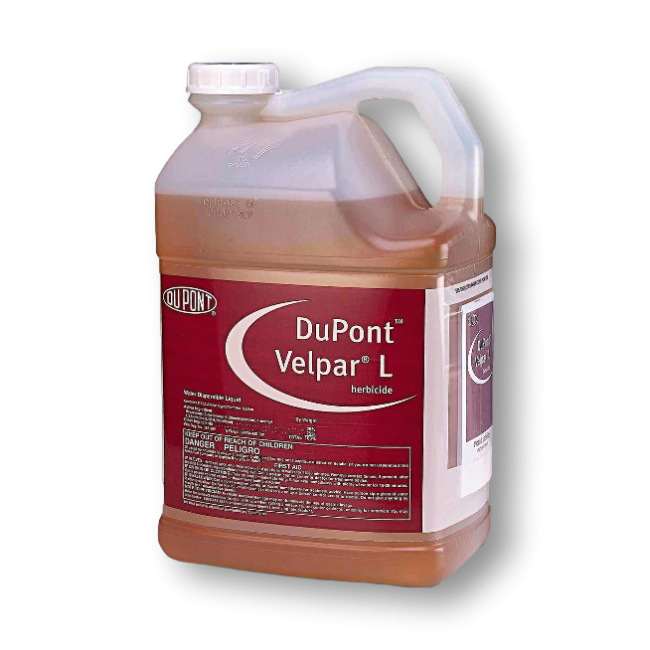
DuPont Velpar L Herbicide
DuPont Velpar L Herbicide is a powerful liquid herbicide designed for selective and non-selective weed and brush control in forestry, industrial, and utility settings.
As low as
$359.10
Only %1 left
SKU
DuPont Velpar L Herbicide Product Page
Min : 359.1 - Max : 359.1

Price as of
04/15/26
04/15/26
Price Transparency
See how our pricing compares to other online retailers for this item.
DuPont Velpar L Herbicide, manufactured by Dupont, is an effective general pre- and post-emergent herbicide that successfully eliminates invasive broadleaf weeds, grasses, and brush across various sites.
This suspended concentrate herbicide contains hexazinone, which works systemically to disrupt plant photosynthesis and cause death. It moves through the plant via foliar and root uptake, making Velpar L ideal for use in various application methods from broadcast sprays to soil spot treatments.
DuPont Velpar L Herbicide is highly effective on woody and weed species that many herbicides struggle to control, which makes it an excellent choice for forestry site preparation and pine release programs, where controlling competing hardwoods is critical for pine growth.
Tools Needed
It can be applied with a boom sprayer, knapsack sprayer, spray rig, chemigation, or helicopter.
How to Use
- Step 1: Determine how much DuPont Velpar L Herbicide to use by measuring the square footage of the treatment area. Find the square footage by measuring the treatment area's length and width in feet, then multiplying them together (length X width = square footage). For acreage, take the square footage and divide it by one acre (square footage / 43,560 sq. ft. = acres). For Christmas tree sites with coarse texture, apply 4 pints of DuPont Velpar L Herbicide per 100 gallons of water per acre. For Christmas tree sites with medium or fine texture, use 7 pints of product per 100 gallons of water per acre. Refer to the product label for specific application rates and restrictions.
- Step 2: Fill the sprayer tank with half the amount of clean water. Add the proper amount of product then pour in the remaining half of the water. Close the tank lid and agitate until mixed.
- Step 3: Apply as a spot or broadcast spray until the top and bottom of weed leaves are wet, but not to the point of runoff.
Where to Use
DuPont Valpar L Herbicide can be used in certain crops, Christmas trees, forestry site preparation and release areas, and industrial areas. It may also be applied undiluted as a basal soil treatment for brush control in reforestation areas, rangeland, pastures, and noncrop areas, or by stem injection for brush control.
When to Use
For best results, apply DuPont Velpar preemergence or postemergence when weeds are less than 2 inches in height or diameter. Foliar activity is most effective under conditions of high temperature (above 80 degrees Fahrenheit), high humidity, and good soil moisture. Foliar activity may be reduced when vegetation is dormant, semi-dormant, or under stress.
Best results are obtained when the soil is moist at the time of application and 1/4–1/2 inches of rainfall occurs within 2 weeks after application.
Specific harvest intervals must be followed as stated on the product label so it would be best to refer to it.
Safety Information
DuPont Velpar L Herbicide is safe for people and pets when applied according to the product label instructions. Always wear the proper personal protective equipment (PPE) when mixing and applying this product.
Keep people and pets out of the treated area until 48 hours have passed after application.
Special Considerations
Care must be exercised when applying DuPont Velpar L Herbicide near desirable trees or shrubs as they can absorb this product through roots extending into treated areas.
| Restricted Use | No |
|---|---|
| Shipping Restrictions | AK, AL, AR, AZ, CA, CO, CT, DC, DE, FL, GA, HI, ID, IL, IN, LA, MA, MD, ME, MI, MN, MO, MS, MT, NC, ND, NE, NH, NJ, NM, NV, NY, OH, OK, OR, PA, SC, SD, TN, TX, UT, VA, VT, WA, WI, WY |
| Availability | Online |
| Signal Word | DANGER |
| Keith's Pro Tip | "In areas where other conifer species may be mixed in with the conifers listed on the label, DuPont Velpar may be applied if the user has prior experience with this product on the other conifer species. With no prior experience, it is advised that either a small area of plantings be tested for conifer safety prior to treating larger areas, or make no application." |
| Time to Kill | On herbaceous plants, symptoms usually appear within 2 weeks after application under warm, humid conditions, while 4–6 weeks may be required when weather is cool or dry, or when plants are under stress. On woody plants, symptoms usually appear within 3–6 weeks after sufficient rainfall has carried the herbicide into the root zone during periods of active growth. Defoliation and refoliation may occur, but susceptible plants are killed. |
| Chemical Type | Herbicide |
| Formulation | Suspended Concentrate |
| Application Methods | Broadcast Spray, Spot Treatment |
| Product Drawbacks | If rainfall after application is inadequate to activate DuPont Velpar L Herbicide in the soil, plants may recover from contact effects and continue to grow. |
| Active Ingredient | Hexazinone 25% |
| Application Equipment | Aerial Application Equipment, Spray Rig |
| Mix Rate | For Christmas tree sites with coarse texture, apply 4 pints of DuPont Velpar L Herbicide per 100 gallons of water per acre. For Christmas tree sites with medium or fine texture, use 7 pints of product per 100 gallons of water per acre. |
| Use Sites | Outdoors |
| Yield | 2.5 gallons of DuPont Velpar L Herbicide will coverage will vary based on soil conditions and application sites. |
| EPA Registration No. | 352-392 |
| Shelf Life | DuPont Velpar L Herbicide will last for 3 years when stored in a dry, clean area. |
| Comparable Products | SFM Extra Pre-emergent Herbicide |
| Children or pets? | Yes |
| Property Characteristics | None |
| Availability | Online |
| Restricted Use | No |
| Brand | DUPONT |
| Keith's Pro Tips | "In areas where other conifer species may be mixed in with the conifers listed on the label, DuPont Velpar may be applied if the user has prior experience with this product on the other conifer species. With no prior experience, it is advised that either a small area of plantings be tested for conifer safety prior to treating larger areas, or make no application." |
| Product Drawbacks | If rainfall after application is inadequate to activate DuPont Velpar L Herbicide in the soil, plants may recover from contact effects and continue to grow. |
| Target Pests | Ageratum, Alder, Alexandergrass, Alfalfa, American Burnweed, American Elm, Annual Bluegrass, Annual Ryegrass, Ash, Aspen, Aster, Bahiagrass, Balsam Poplar, Balsamapple, Barnyardgrass, Baronetgrass, Bentgrass, Bermudagrass, Bigtooth Aspen, Bindweed, Birch, Black Cherry, Black Oak, Blackberry, Blackgum, Blue Mustard, Bluegrass, Bouncingbet, Boxelder, Bracken Fern, Brambles, Briers, Bristly Foxtail, Broadleaf Panicum, Broadleaf Signalgrass, Bromegrass, Broomsedge, Browntop Panicum, Buffalograss, Buffelgrass, Burdock, Camphorweed, Canada Bluegrass, Canada Thistle, Carolina Geranium, Catclaw Acacia, Catsclaw, Catsear, Cheat, Cherry, Chickweed, Chinaberry, Chinese Elm, Chinese Tallowtree, Chokecherry, Cholla Cactus, Cinquefoil, Clover, Cocklebur, Common Chickweed, Common Dandelion, Common Groundsel, Common Lambsquarters, Common Mallow, Common Ragweed, Corn Spurry, Crabgrass, Crotalaria, Crownvetch, Curly Dock, Dallisgrass, Dandelion, Deerbrush Ceanothus, Dewberry, Dogbane, Dogwood, Downy Brome, Eastern Red Cedar, Elk Sedge, Elm, English Catchfly, Fall Panicum, False Dandelion, Falsedandelion, Fescue, Fiddleneck, Field Pennycress, Filaree, Fingergrass, Fleabane, Flixweed, Flora'S Paintbrush, Flowering Dogwood, Foxtail, Foxtail Barley, Fuzzy Crotalaria, Goatsbeard, Goatsbeard Vine, Goldenrod, Goosegrass, Graceful Spurge, Grasses, Green Ash, Greenleaf Manzanita, Guineagrass, Hackberry, Hairy Crabgrass, Hairy Morningglory, Hardwoods, Hawkweed, Hawthorn, Hazel, Heath Aster, Henbit, Herbaceous Weeds, Hialoa, Hickory, Hila Hila, Honeysuckle, Horseweed, Huisache, Italian Ryegrass, Itchgrass, Ivyleaf Speedwell, Jim Hill Mustard, Jimsonweed, Job'S Tears, Johnsongrass (Seedling), Junglerice, Juniper, Koa Haole, Kochia, Lambsquarters, Lantana, Large Crabgrass, Lespedeza, Little Barley, Live Oak, Locust, London Rocket, Lotebush, Manzanita, Marestail, Maypop Passionflower, Mayweed, Mayweed Chamomile, Meadowsweet, Mesquite, Mexicantea, Milkweed, Minerslettuce, Morningglory, Mulberry, Multiflora Rose, Mustard, Myrtle, Myrtle Oak, Natalgrass, Nutsedge, Oak, Orchardgrass, Osageorange, Oxalis, Oxeye Daisy, Panicgrass, Panicum, Paragrass, Paspalum, Pearly Everlasting, Pennsylvania Smartweed, Pepperweed, Perennial Bluegrass, Perennial Grasses, Perennial Ryegrass, Persimmon, Pigweed, Pin Cherry, Pinegrass, Pinnate Tansymustard, Plantain, Popolo, Prickly Lettuce, Privet, Prostrate Spurge, Purslane, Purslane Speedwell, Quackgrass, Radiate Fingergrass, Ragweed, Raspberry, Red Maple, Red Oak, Red Sorrel, Redcedar, Redroot Pigweed, Ricegrass, Richardsonia, Russian Thistle, Ryegrass, Salsify, Sandbur, Sassafras, Sensitiveplant, Sheep Laurel, Sheep Sorrel, Shepherdspurse, Showy Crotalaria, Slender Amaranth, Small Soapweed, Smartweed, Smooth Amaranth, Smooth Crabgrass, Smooth Pigweed, Smutgrass, Snowbrush Ceanothus, Soapweed, Sour Paspalum, Sourwood, Southern Red Oak, Sowthistle, Spanishneedles, Spiny Amaranth, Sprangletop, Spurge, Spurry, Squawcarpet, Starthistle, Sumac, Sunflower, Sweetbay Magnolia, Sweetgum, Swollen Fingergrass, Tallowtree, Tansymustard, Tarweed, Tarweed Cuphea, Tarweed Fiddleneck, Texas Panicum, Threelobe Morningglory, Trailing Blackberry, Trembling Aspen, Trumpetcreeper, Varnishleaf Ceanothus, Vaseygrass, Velvetgrass, Water Oak, Weeds, White Cockle, White Oak, Whitebrush, Whitethorn, Whitethorn Acacia, Wild Barley, Wild Blackberry, Wild Buckwheat, Wild Carrot, Wild Cherry, Wild Mustard, Wild Oat, Wild Parsnip, Wild Plum, Wild Radish, Wild Rose, Wild Strawberry, Willow, Willowweed, Winged Elm, Witchgrass, Woody Plants, Yarrow, Yellow Foxtail, Yellow Poplar, and Yellow Rocket. |
| Application Equipment | Aerial Application Equipment, Spray Rig |
| Application Methods | Broadcast Spray, Spot Treatment |
| Active Ingredient | Hexazinone 25% |
| Product Type | Herbicide |
| Formulation | Suspended Concentrate |
| Application Rate | For Christmas tree sites with coarse texture, apply 4 pints of DuPont Velpar L Herbicide per 100 gallons of water per acre. For Christmas tree sites with medium or fine texture, use 7 pints of product per 100 gallons of water per acre. |
| Shelf Life | DuPont Velpar L Herbicide will last for 3 years when stored in a dry, clean area. |
| Yield | 2.5 gallons of DuPont Velpar L Herbicide will coverage will vary based on soil conditions and application sites. |
| Use Sites | Outdoors |
| Time to Kill | On herbaceous plants, symptoms usually appear within 2 weeks after application under warm, humid conditions, while 4–6 weeks may be required when weather is cool or dry, or when plants are under stress. On woody plants, symptoms usually appear within 3–6 weeks after sufficient rainfall has carried the herbicide into the root zone during periods of active growth. Defoliation and refoliation may occur, but susceptible plants are killed. |
| Comparable Products | SFM Extra Pre-emergent Herbicide |
| EPA Registration # | 352-392 |

*Price does not include freight. We guarantee our rate plus shipping will be less than anyone else's price.